Nobody opens a salon because they love spreadsheets. Nobody trains for years as a therapist to chase unpaid invoices on a Sunday night. Yet small business admin quietly takes over the week of almost every owner-operator in the country. So we asked them about it. Between 18 April and 20 May 2026, we surveyed 217 UK service business owners. The mix ran from hairdressers and personal trainers to tutors, therapists, photographers and consultants. Below are the seven jobs they would hand over tomorrow, and the numbers that explain why.
1. Chasing people for money
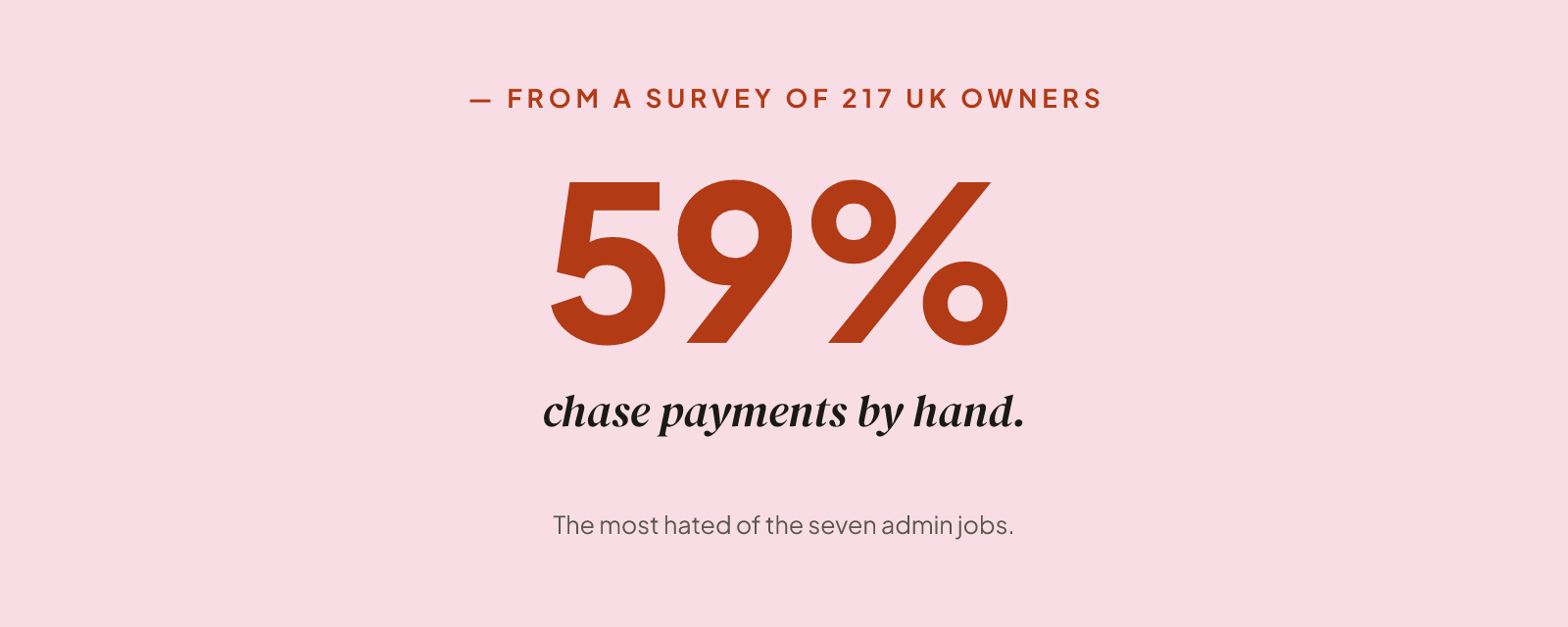
This one wins by a mile. In our survey, 59% of owners chase clients for payments or deposits by hand. That means writing the awkward message, waiting, then writing it again.
It is not just tedious. It is emotional work, because you are asking someone you like for money they already owe you. And the scale is national. Research published by the UK government found affected businesses spend an average of 86 hours a year chasing late payment. Across the economy, that is roughly 133 million hours of staff time.
The government's own view is blunt. It has promised the toughest crackdown on late payments in a generation, and has now put legislation before Parliament.
Tackling late payment is one of the biggest things the government can do to help small businesses grow.
2. Juggling six apps that refuse to talk to each other
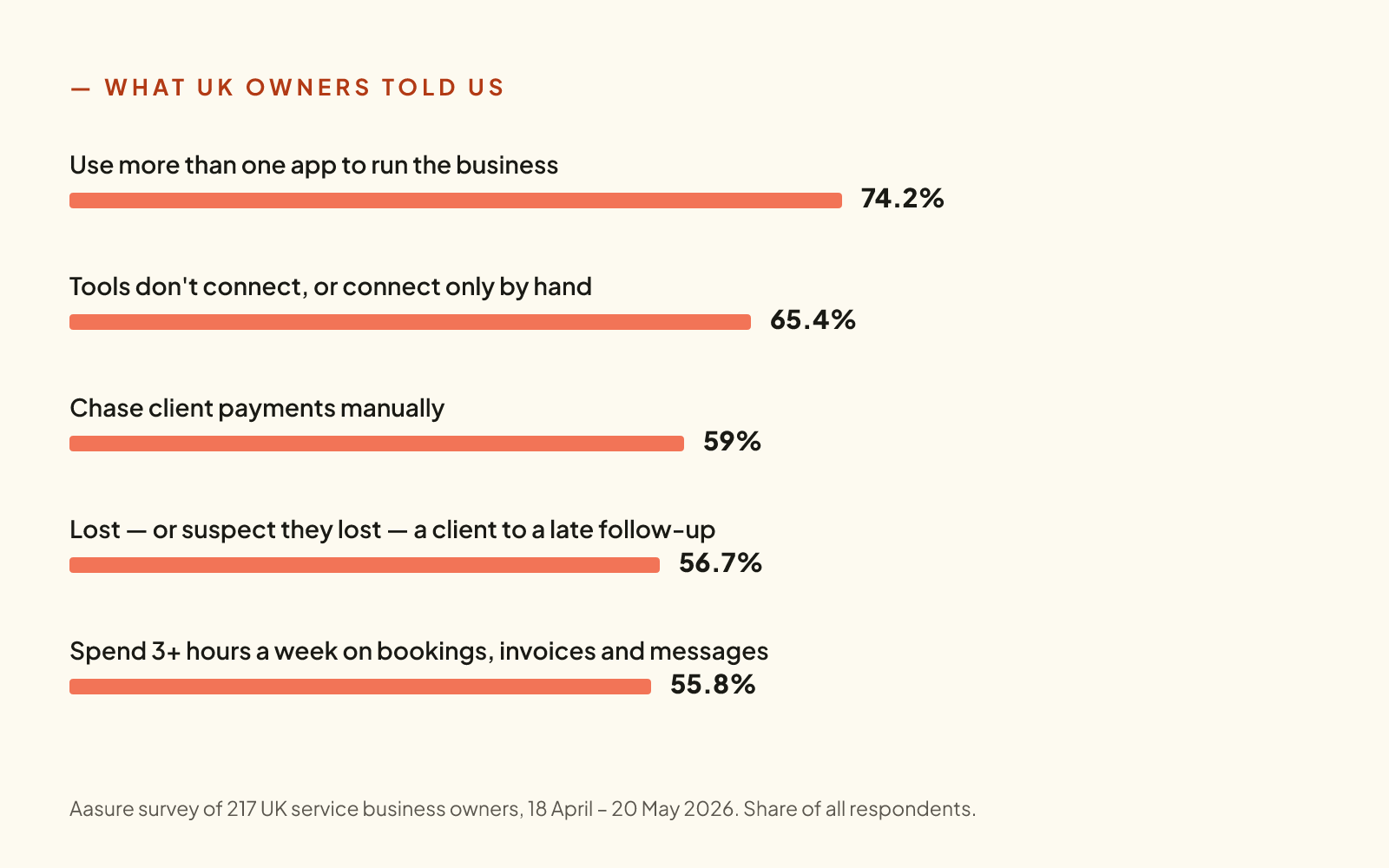
Here is the quiet epidemic. 74.2% of owners use more than one app to run the business. Meanwhile, 65.4% say their tools either do not connect at all or only connect manually.
Put the answers together and 53% are running a stack of tools that do not speak to each other. In practice, that means copying a name from a booking app into a spreadsheet. Then into an invoice. Then into a reminder.
Because the copying is manual, it is also where mistakes creep in. Wrong date. Wrong price. Wrong client. Nearly all small business admin errors start right here.
3. The Sunday night invoice session
Almost every owner we spoke to has one. It usually starts after dinner and finishes far too late.
Invoicing is a small job that never stays small. First you find the notes. Then you work out what was actually delivered. Finally you send it, and the chasing starts all over again — see job number one.
The pattern has a price tag. Sage's research on the hidden admin burden found the average small business works 13 months for 12 months' pay. Two days of every month go on financial admin such as invoicing and chasing.
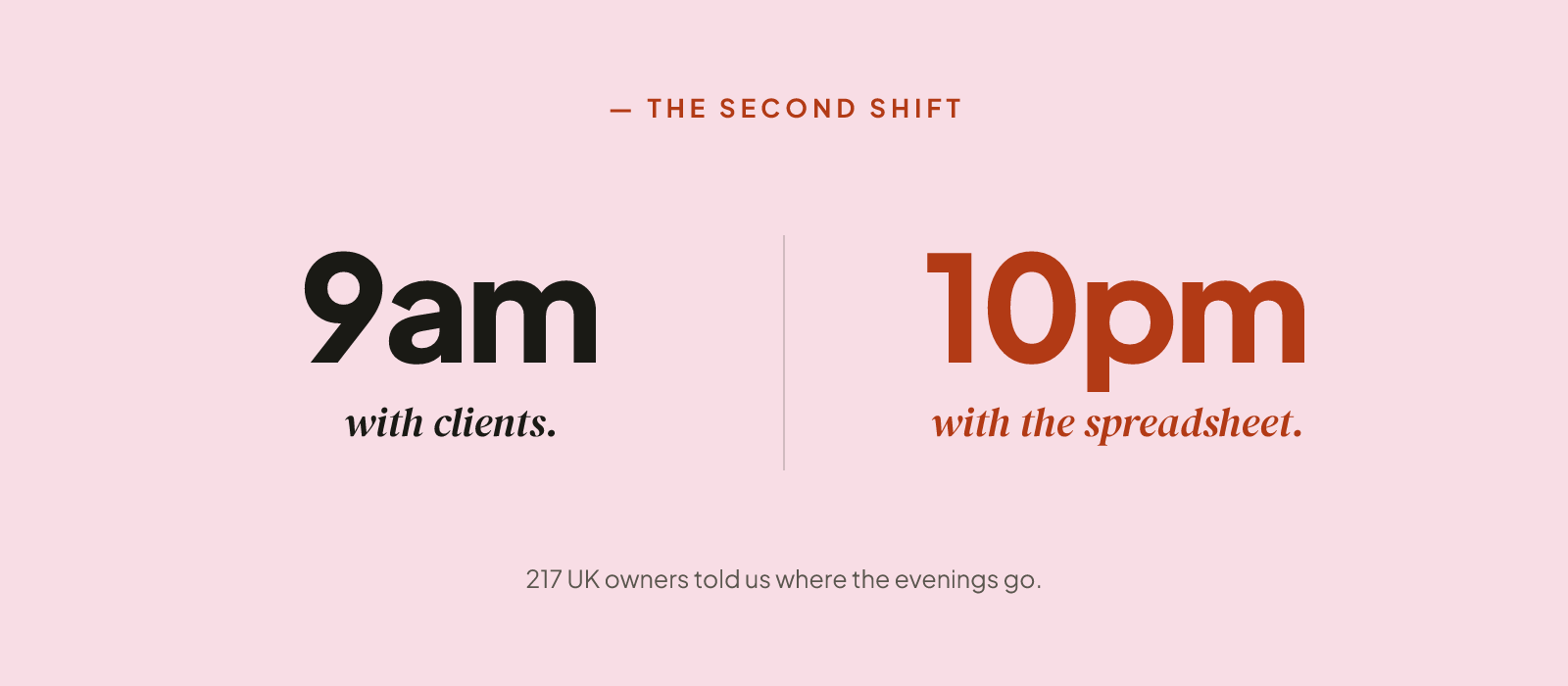
4. Answering "are you free Thursday?" at 10pm
Messages arrive whenever clients think of you. That is usually late at night, or during your lunch break.
Every one of these looks tiny. Together, they are a second shift. You check the diary, reply, wait, then check again when they change their mind.
Above all, this job never batches well. It has to happen quickly or you lose the booking — which brings us neatly to the next one.
5. Remembering to follow up
This is the most expensive job on the list, and the one owners feel worst about. In our survey, 23.5% have lost a client because a follow-up went out too late. Another 33.2% suspect they have. That is 56.7% in total. Meanwhile, only 36.9% could answer with a confident no.
In other words, more than half of UK owners have watched real money walk out of the door. Not because the work was poor. Simply because the follow-up sat in someone's head instead of a system. Our guide to building an enquiry follow-up system covers the fix in detail.
- Enquiries go cold in hours, not days.
- Lapsed clients rarely announce that they have left.
- A single missed rebook can cost hundreds over a year.
6. The empty chair
No-shows and last-minute cancellations are the jobs nobody wants, because there is no good version of them. You lose the slot, the income and the mood.
Then the admin starts. You message the client, try to refill the slot, update the diary, and decide whether to charge a fee. Deposits and reminders help a lot. Still, setting them up and running them by hand is yet another task on a long list. Our free No-Show Cost Calculator puts a real annual number on this one.
7. The three hours that vanish every week
Finally, there is the job that is really all the others added together. 55.8% of the owners we surveyed spend more than three hours a week on bookings, invoicing and client messages.
Three hours a week is about 156 hours a year — close to four full working weeks. For a solo owner charging £50 an hour, that is roughly £7,800 of billable time. It went on small business admin rather than clients. Most owners never see this number, because nobody adds it up. Our free Admin Hours Calculator adds it up.
What the research says about small business admin
Read together, the findings point at one thing. UK owners are not disorganised, and they are not short of software either. In fact, 47% already pay for at least one business tool, and only 12% use none at all.
The problem is that the tools report on the work rather than doing it. As a result, the owner is still the glue holding everything together. Trade bodies see the same picture. The FSB's late payment hub exists because members keep asking about exactly these jobs. So does the NHBF's business guidance for hair and beauty.
That is also why 81.6% of the owners we surveyed would switch to a single connected platform. They are not asking for another dashboard. They want the jobs above to simply happen. It is what Aasure is built to do, across every trade we surveyed.
How to give up small business admin without giving up control
You do not need to fix all seven at once. Instead, start with the one that costs you most.
- Measure it first. Track one week honestly, because most owners underestimate by half.
- Kill the copying. Any job that moves the same information between two apps is worth automating.
- Automate the money. Deposits, reminders and payment chasing pay for themselves fastest. If a client still will not pay, the Small Business Commissioner can help.
- Put follow-ups in a system. Never in your head.
- Go digital before HMRC makes you. Above £50,000, Making Tax Digital already requires digital records — so the switch pays twice.
- Review after 30 days. Keep what saved time, and drop what did not.
Research note: every survey percentage comes from Aasure's UK survey of 217 service business owners. Fieldwork ran from 18 April to 20 May 2026.
Common questions
How much time does small business admin really take?
In our UK survey, 55.8% of owners spend over three hours a week on bookings, invoicing and messages. That is roughly 156 hours a year, or close to four working weeks.
What is the most hated admin job?
Chasing payments. In our survey, 59% of UK owners still do it by hand. Most describe it as the single worst part of the week.
Can small business admin be automated?
Yes, most of it can. Bookings, reminders, invoices, payment chasing and follow-ups all run on rules, so software can handle them end to end.
Does automating admin lose the personal touch?
Not if you stay in control. Good tools let you approve messages before they send, so clients still hear your voice.
The admin that does itself.
Aasure takes these seven jobs off your plate — bookings, reminders, invoices, chasing and follow-ups — for one flat price. You approve what goes out; it does the remembering.
Join the Waitlist → Or: work out your own admin hours →