Here's a question nobody asks when you go self-employed. How much of your working day do you actually get paid for? That answer is your real hourly rate, and it is rarely the number on your price list.
Most PTs set a session rate and do the maths on client numbers. So they think that's the full picture. But one huge part of running a PT business never shows up in an income calculator. Meanwhile it eats into your earnings every week.
We mean the hours spent on booking requests, chasing payments and creating invoices. Then there is rescheduling, answering WhatsApp questions, and tracking who owes you what. None of that time is billable. All of it is real work.
So let's actually do the maths.
The real hourly rate maths nobody does
Let's say you charge £60 per session. You train 20 clients a week. On paper, that's £1,200 a week, or roughly £4,800 a month. Sounds solid. But that is turnover, not income. As a self-employed sole trader you still owe Income Tax and National Insurance on it.
But here's what that calculation is missing.
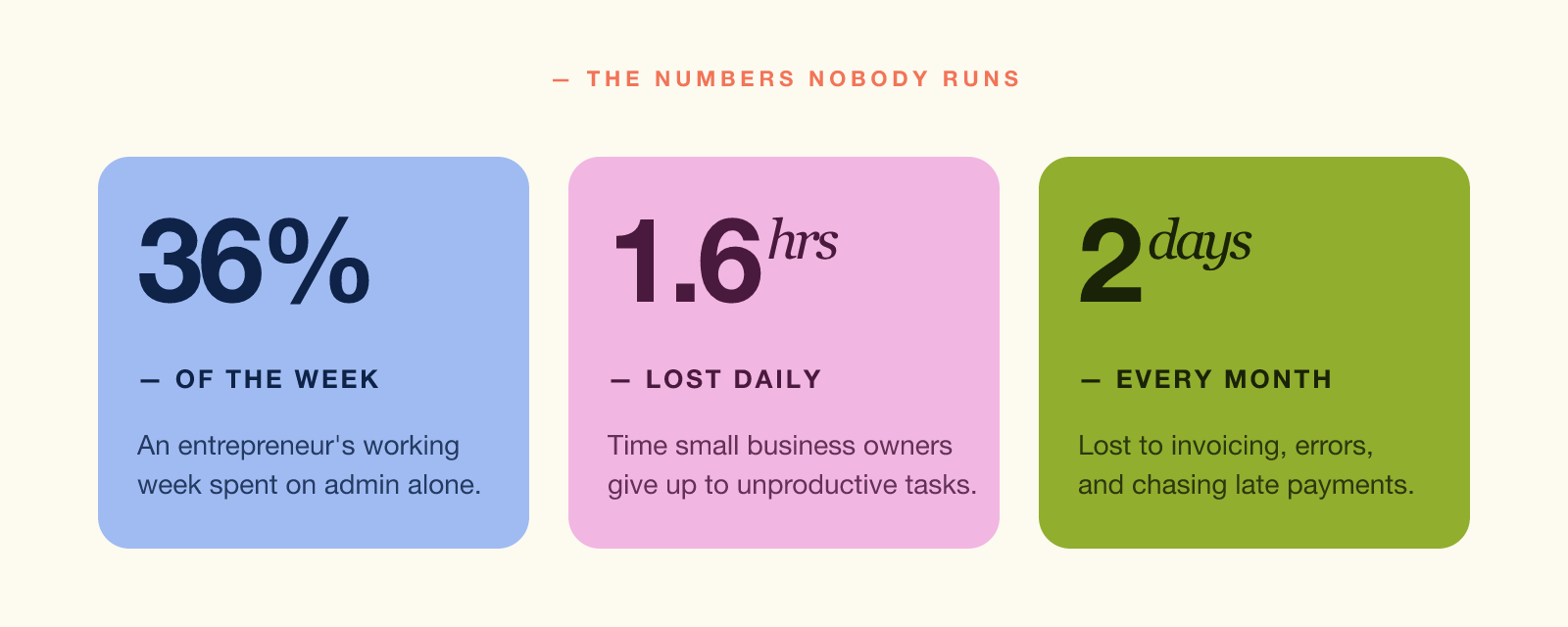
These aren't made-up numbers. A study of entrepreneurs found that 36% of the working week goes on admin. Meanwhile the Small Business Charter reports the same burden across UK SMEs.
Now let's apply them to your PT business.
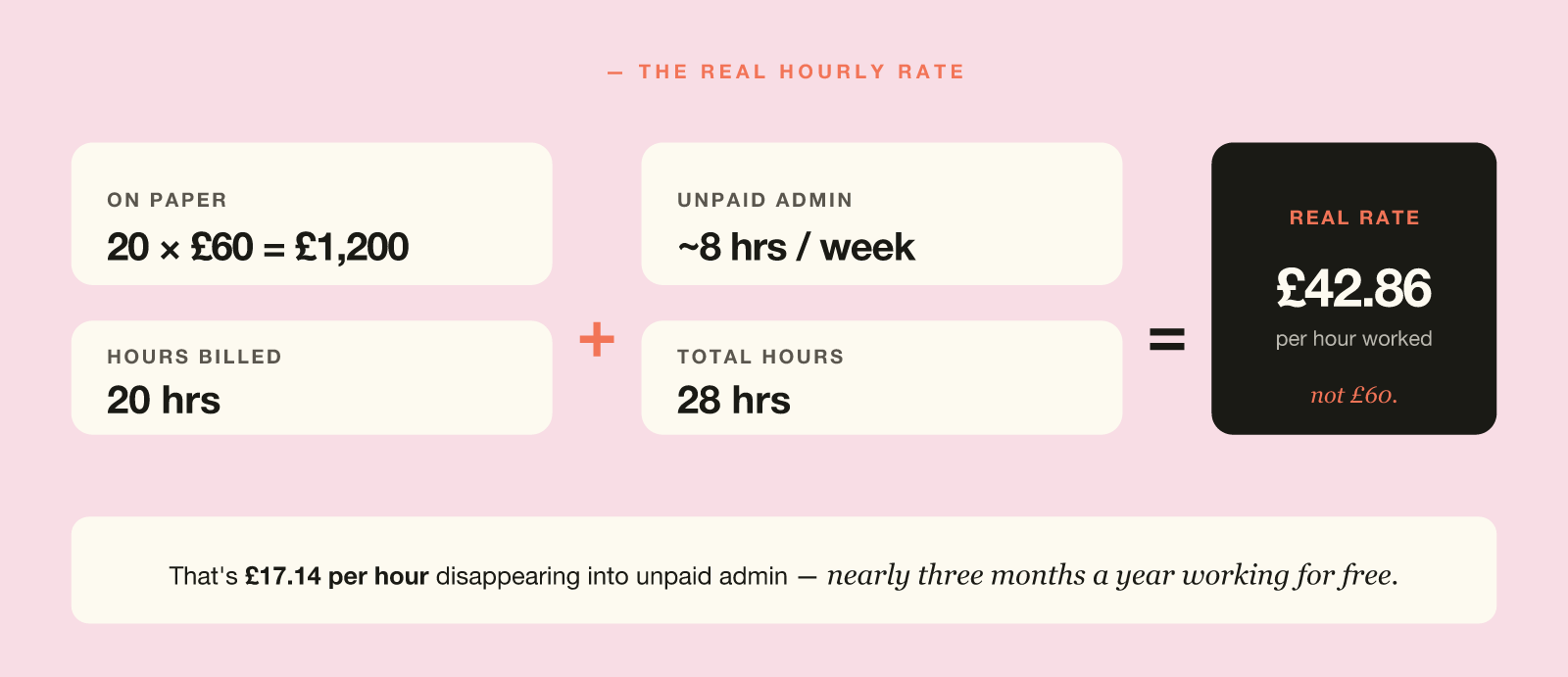
That's nearly £17 an hour disappearing into time you never get paid for. Over a full year, that's the equivalent of working almost three full months for free.
And eight hours of admin a week? For many PTs, that's actually a conservative estimate.
Where Are Those Hours Actually Going?
Let's break down what "admin" actually means for a personal trainer. It is very easy to underestimate how much there is. For context, ONS earnings data measures paid hours only. So unpaid admin never shows up in the averages you compare yourself against. Nor does it appear in the standards set by CIMSPA, the sector's chartered body.
Booking and scheduling
- Replying to new enquiries by text, Instagram DM, or WhatsApp
- Going back and forth with clients to find a time that works
- Manually updating your calendar every time something changes
- Confirming sessions the day before so people actually show up
- Rescheduling when clients cancel last-minute — and they will
Without a proper booking system for small businesses, all of this is manual. It adds up to far more than you'd think. Especially with 20-plus clients all doing it at different times.
Invoicing and getting paid
- Creating individual invoices for each client, every month
- Sending payment reminders to anyone who's late
- Chasing clients who have somehow missed three reminders
- Manually tracking who's paid and who hasn't
- Fixing mistakes when you've invoiced the wrong amount
Client management
- Keeping notes on each client's progress somewhere that isn't your brain
- Remembering who's on which programme and how many sessions they have left
- Following up with clients you haven't heard from in a while
- Onboarding new clients — forms, contracts, payment setup
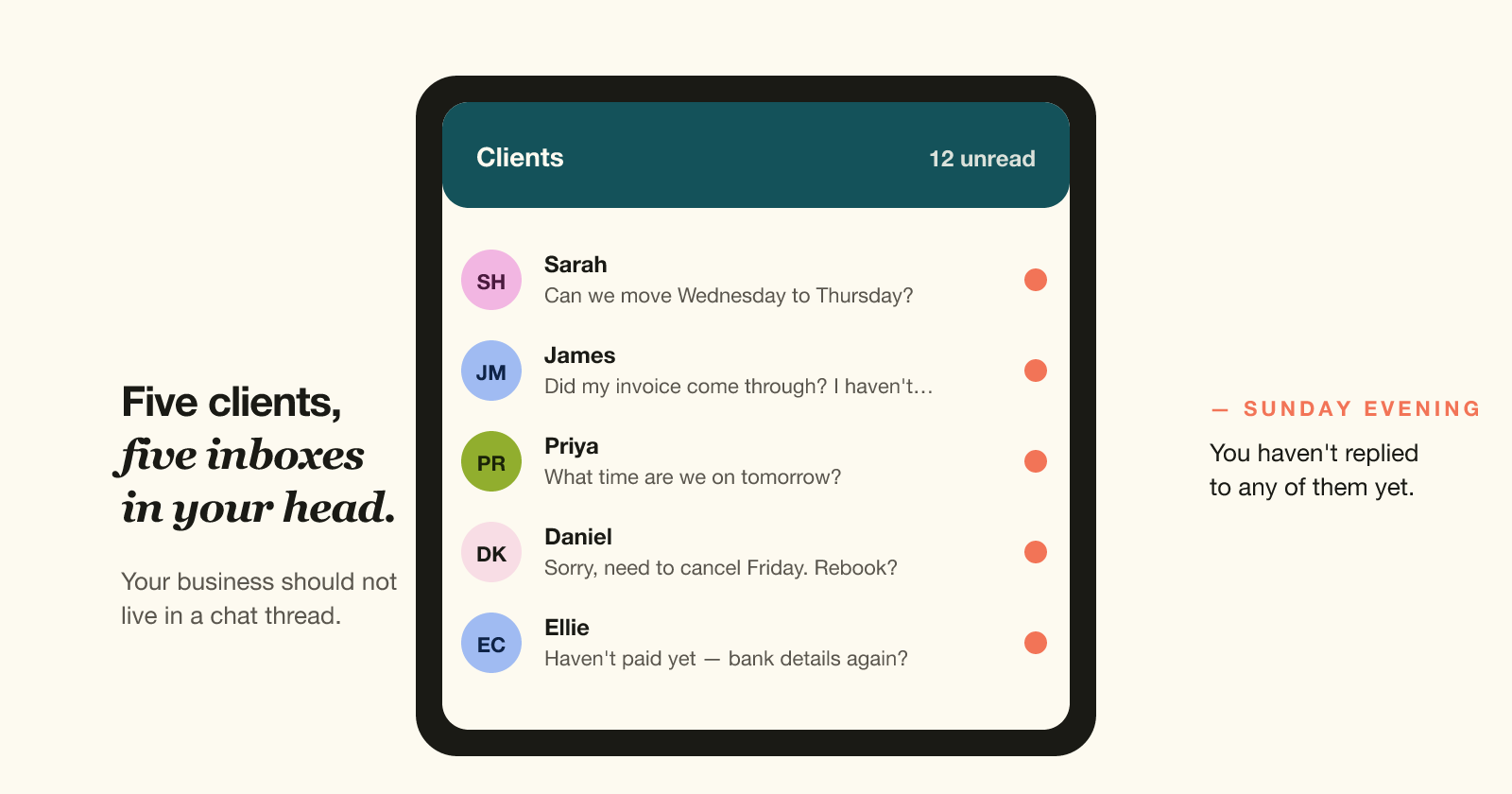
This is the stuff nobody told you about when you got your Level 3. You trained to train people. Instead you spend Sunday evenings on work that scheduling software could handle automatically. Meanwhile the job you love waits.
The Hidden Cost Isn't Just Money
Think about this. Every admin hour is an hour you could have spent training an extra client. Or building an online programme, or training yourself, or simply switching off. The cost isn't only financial — it's your time, your energy, and your ability to grow.
There's a term for this in business: working in your business instead of working on it. When you're buried in admin, you're not improving your service, finding better clients, or building something that can grow. You're just keeping the wheels from falling off.
Surveys of UK small business owners put the admin burden at roughly a third of the week. So most of your time goes on running the business rather than growing it. For solo PTs with no staff, that split is often worse still.
So What Do You Actually Do About It?
The answer isn't to work harder or put in longer hours. The answer is to stop doing manually what a system can do automatically.
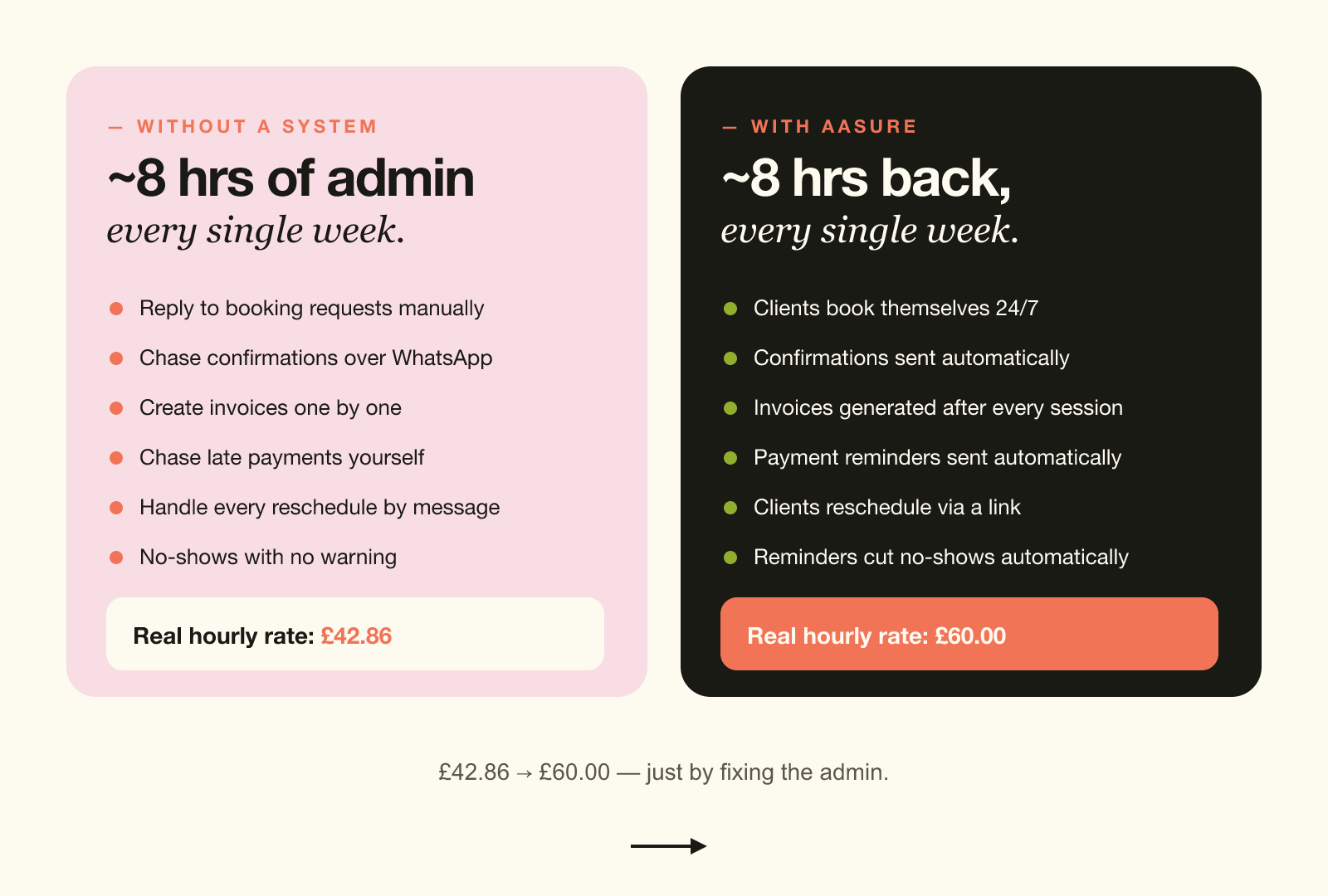
The right all-in-one business management software handles booking, confirmation and reminders. So you never lift a finger. Clients pick a slot from your live availability. Then they get a confirmation automatically, and a reminder before the session. If they need to move it, they reschedule through a link. In short, no WhatsApp message reaches you.
Invoicing should work the same way. Once a session is completed, an invoice goes out automatically. Payment reminders chase clients who haven't paid. You see your outstanding balance at a glance. No spreadsheets. No Sunday evening admin sessions.
When everything lives in one place, you stop jumping between five apps. That means bookings, client history, payments and communications together. That's the real difference between a business that runs you and a business you actually run.
Audit your real hourly rate this week
Here is a challenge. For just one week, track every minute you spend on non-billable work. You will need the figure anyway. After all, HMRC lets you claim allowable expenses against it. Besides, Making Tax Digital is being phased in. Be honest. Count the WhatsApp replies, the invoice chasing, the calendar reshuffling, the rescheduling conversations.
Most PTs who do this exercise are genuinely shocked by the number they arrive at. And once you can see it clearly, it becomes very hard to keep ignoring it.
Your session rate is one part of the picture. Your total working hours are the other part. So the only way to earn what you're worth is to bring those two back into line. In practice that means getting serious about your systems.
You got into personal training because you're brilliant at it. The admin was never supposed to be the job.
It's time to stop letting it be.
Run your own numbers.
Use the free Real Pricing Calculator. It shows the minimum session price you need to break even, and the recommended price that gives you breathing room. No sign-up.
Open the calculator →