PT client retention is mostly a noticing problem. Clients almost never quit out of nowhere. They send signals first, and the signals are quiet. So if you can read them early, you can usually save the client.
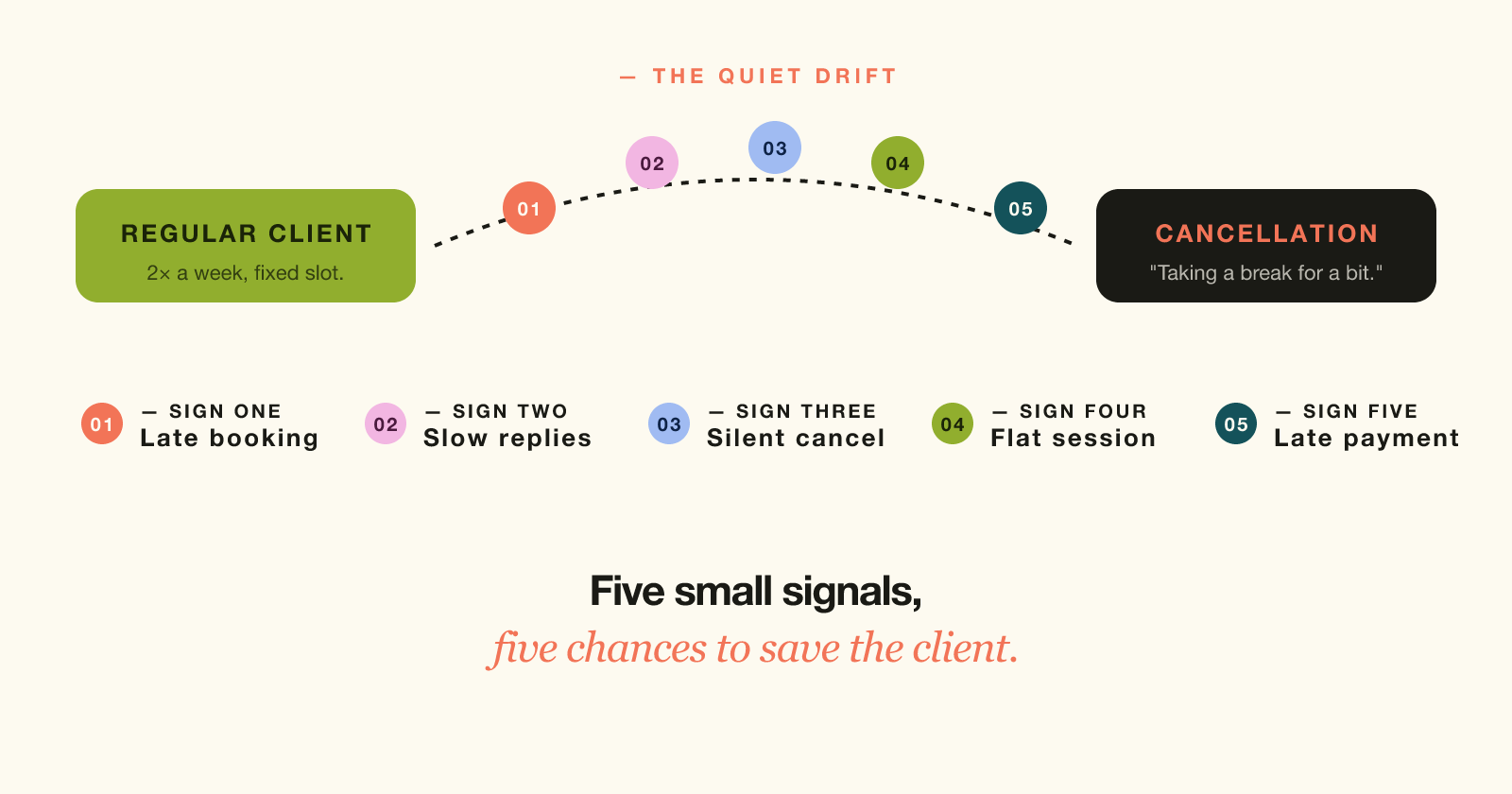
You know the shape of it already. First a regular books fewer sessions one month. Then they cancel a Tuesday. Then work gets busy. Finally a polite text arrives: "Hey — think I'm going to take a break. Will be in touch soon."
You never hear from them again.
Why PT client retention is a numbers problem first
The drift is not just a feeling. In fact researchers have measured it. In a year-long study of 250 new fitness-club members, 20% had dropped out by month three. By twelve months that figure reached 28.3%. Only 37% trained regularly across the whole year.
The same group reported attendance rates of 10 to 37% in the first months after sign-up. Meanwhile a large US trial of 947 adults found 31% dropped out, and two-thirds of those left before month one.
So the leak is not unusual. It is the normal shape of a client base. But it is also early, which means the warning signs arrive long before the cancellation text does.
Warning sign 1 — They start booking last minute
A regular used to book a week ahead. But now they text you on Sunday night for a Monday slot. Or they stop booking until you nudge them.
What it usually means: Training has stopped being a fixed part of the week. The habit is breaking. Other things creep into the slot instead — work calls, school runs, a lie-in.
That pattern shows up in the national data too. Sport England's Active Lives survey tracks how consistently adults keep moving, and consistency is what slips first.
What to do: Bring back the structure. Move them onto a fixed weekly slot, same day and same time. Then pre-book the next four weeks together at the end of your next session. A booking system for small businesses can lock in recurring slots in seconds.
The goal is to take the decision off their plate. After all, people rarely quit habits that are already on the calendar.
Warning sign 2 — They stop replying quickly
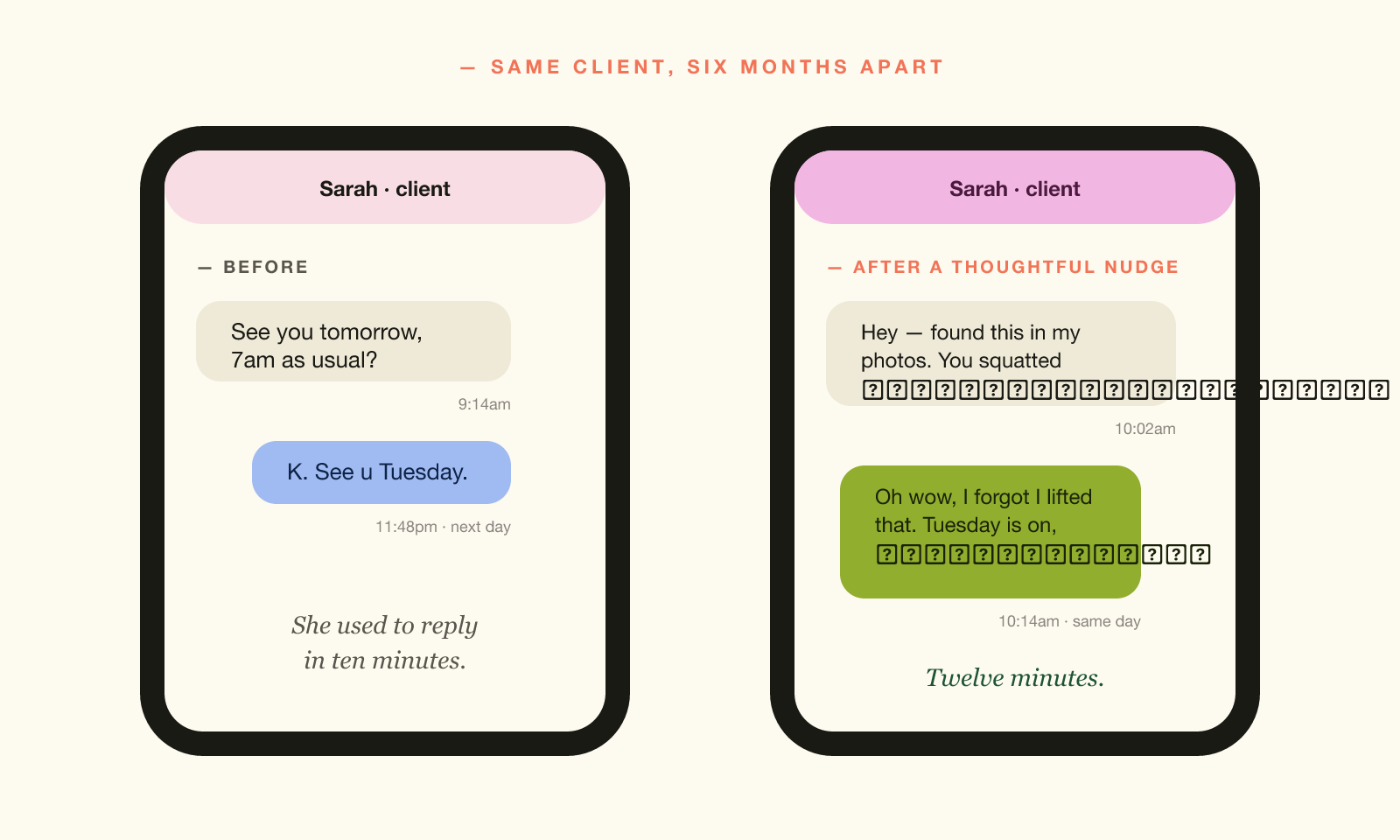
Three months ago your client replied to a "see you tomorrow" text within ten minutes. Now it takes a day, and sometimes two. Sometimes you send the message twice.
What it usually means: The relationship has cooled. They are not annoyed with you. Instead, they have stopped feeling invested in the training.
What to do: Send something that is not about the next session. For example, a short voice note about something they told you. Or a photo of their old programme card with a "look how far you've come" line.
This works because it reminds them you see a person, not a slot. In fact a single thoughtful message can reset months of drift.
Warning sign 3 — They cancel and don't rebook
Healthy clients cancel sometimes, because life happens. So the signal is not the cancellation itself. It is what happens next.
A committed client rebooks within a few hours. "Sorry, can't do Wednesday — could we do Friday morning instead?"
A client about to drop off cancels and goes quiet. The slot vanishes and nothing replaces it.
This is the strongest signal you have, and there is evidence for that. One study used machine learning on 5,209 fitness-centre members to predict who would leave. The top predictor was non-attendance days. Then came length of membership and total amount billed.
What it usually means: The session has stopped feeling essential. They are testing what life feels like without it.
What to do: End every cancellation reply with a rebook, not a question. Instead of "let me know when you're free," try "same time Friday, or shall we move you next week?"
Better still, let your scheduling software for small businesses handle it. When someone cancels, the system shows the next open slots and asks them to pick one.
Warning sign 4 — They stop engaging in the session
The session itself is the clearest sign of all. Yet it is also the easiest to miss, because you are busy teaching it.
Look for:
- Quieter than usual, less chat between sets
- Phone out more often
- Excuses creeping in ("haven't slept," "feeling off," "work stress")
- Going through the motions instead of pushing
What it usually means: Something outside training has taken over their headspace. So the session now feels like an obligation rather than a refuge.
What to do: Do not push harder. Ease off, finish on something they enjoy, then have a real conversation at the end. Then ask what is going on, and listen.
Then offer a small adjustment. A shorter session, a different time, or a different focus for a few weeks. Remember that the NHS baseline is 150 minutes of moderate activity a week, plus two strengthening sessions. The UK Chief Medical Officers' report sets out the same target.
In other words, a lighter block still counts. Clients rarely quit a coach who notices and adapts.
Warning sign 5 — Their payments slip
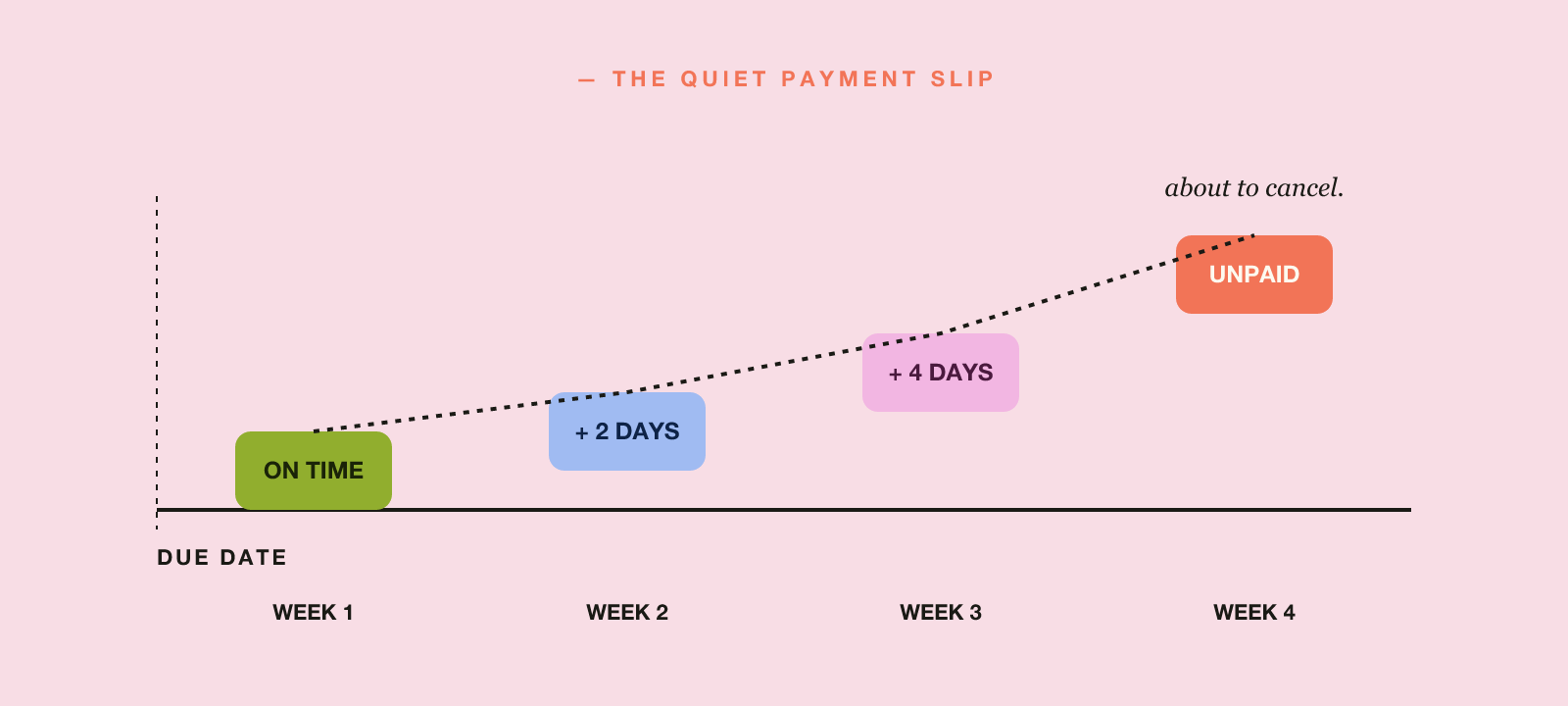
Most PTs spot this one last, since nobody enjoys looking at the money side. Yet payments are one of the most honest signals you have.
Watch for a committed client who suddenly:
- Pays a few days late instead of on time
- Asks if they can pay next week
- Goes quiet when an invoice goes out
- Buys fewer sessions than usual at top-up time
Those clients are very often about to cancel. The dropout research above found the same thing: total amount billed ranked among the three strongest predictors. In short, the payment slip is them quietly making space to leave.
What to do: Do not ignore it, and do not make it awkward. Send a short, friendly message that names the situation without putting them on the defensive. Something like this works:
"Hey — noticed last month was a busy one. Just checking in. Do you want to keep your usual two sessions a week? Or shall we drop to one while things settle? No problem either way."
Clients often reply "actually, can we do one for now?" Then they stay another two years instead of disappearing.
This is one small reason an all-in-one business management software pays for itself. When bookings, payments and client history sit in one place, the pattern is obvious. So you spot the slip in week two, not month three.
What PT client retention really comes down to
You cannot save every client. After all, people move, lose jobs, have babies and change priorities. That is normal, and it is not a reflection on your coaching.
But most cancellations are not really about the training. They are about a slow drift that nobody named. So build the habit of watching for these five signals, and act on them early and kindly. Over a year that habit is worth more than any marketing you could run.
If you want a formal benchmark, CIMSPA is the chartered body for the UK sector. It sets the professional standards most trainers work to.
- Who's booking last-minute that used to plan ahead? Offer a recurring slot.
- Whose replies have slowed? Send something that isn't about the next session.
- Who cancelled this week and didn't rebook? Reach out with two options, not a question.
- Who felt flat in their last session? Have the real conversation, then adapt.
- Whose payment is late? Acknowledge it kindly before it gets awkward.
You got into personal training because you love changing people's lives. The retention work was never supposed to feel like guesswork. It's time to stop letting it be.
Stop bleeding bookings quietly.
The next read: a step-by-step guide to writing a no-show policy. It protects your income without awkward conversations, and it keeps drifting clients honest.
Read the no-show guide →