Picture this. It is 10am on a Tuesday. You have prepped the room, mixed the tint, and set aside an hour and a half. Then your client does not show up. No message. No call. Nothing. Without a no-show policy, you absorb that cost silently — and it happens again next week.
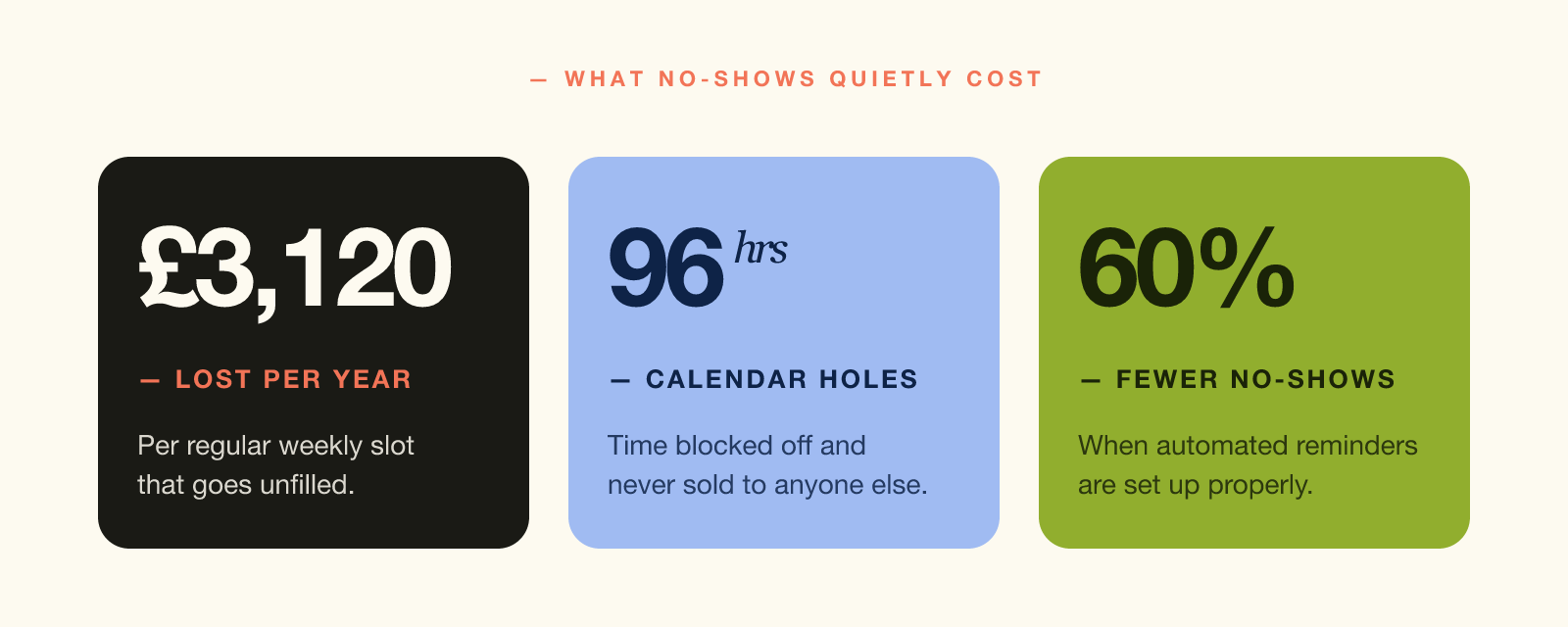
But a no-show does not just cost you one appointment. It costs you the slot you could not fill. Equally, it costs the prep time you cannot get back. Worse, it costs the mental reset you need before the next client walks in. If this happens twice a week, you could be losing hundreds of pounds every single month.
The good news? Fortunately, a clear no-show policy fixes this almost overnight. And no, it does not have to feel rude or scary. You are still running a beauty business, not a bank.
So this guide walks you through every step. What to include. How to tell clients. Finally, how to enforce it without losing relationships.
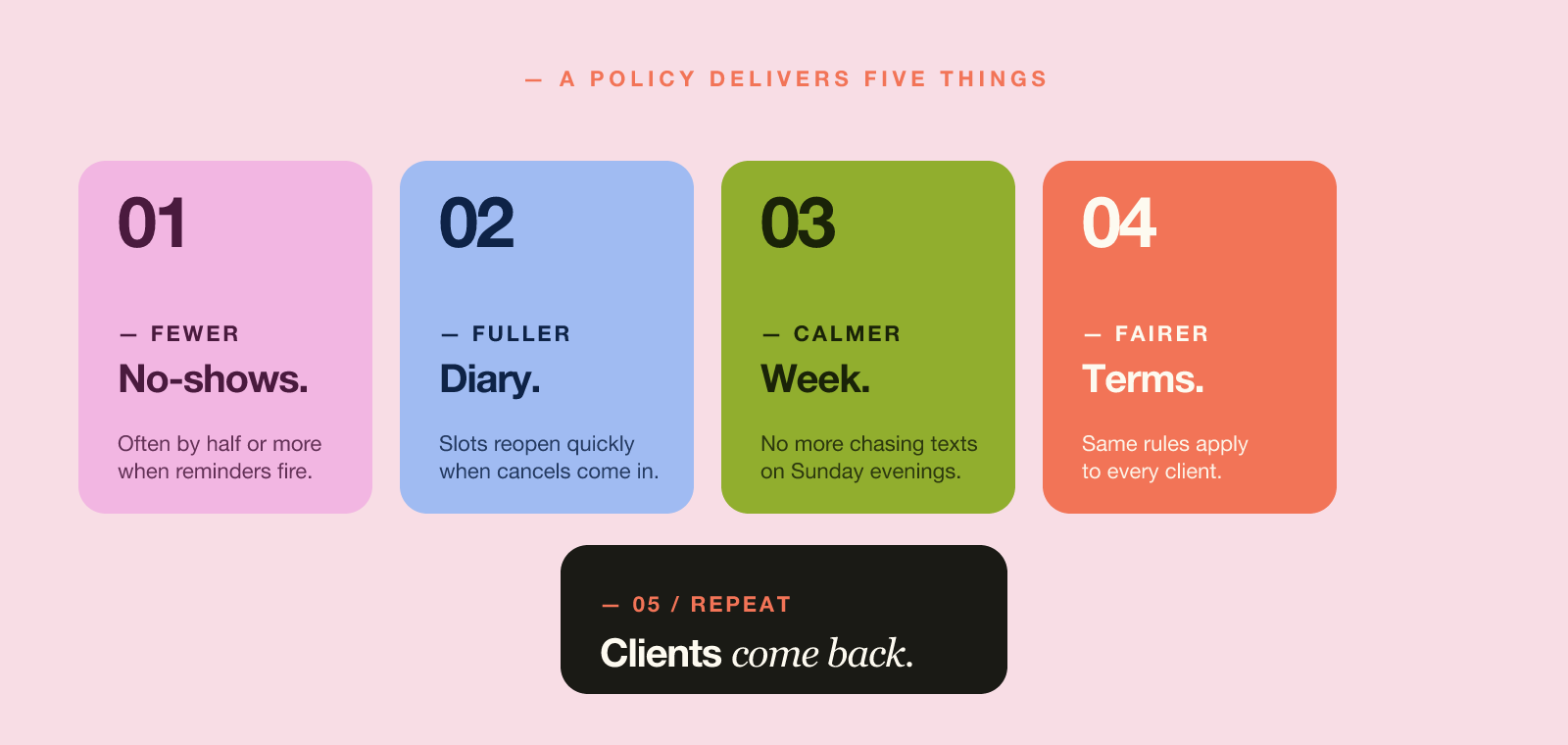
Why most beauty therapists avoid having a no-show policy (and why that's costing them)
Most salon owners and aestheticians feel uncomfortable charging for no-shows. Indeed it feels harsh. You do not want to upset someone you have built a relationship with. You worry they will not come back.
But here is the truth: not having a policy is not kinder to your clients. It just means they have no reason to take their booking seriously.
Think about it from their side:
- If cancelling costs them nothing, they will cancel without thinking twice
- If there is no reminder system in place, they will simply forget
- If they know you will not say anything, last-minute messages become a habit
The scale is not trivial either. Trade press reported that UK beauty businesses lost £2.6 million to no-shows in one summer. A no-show policy is not about being mean. It is about being professional. After all, every serious business has one — from your dentist to your hairdresser to your hotel. Yours should too.
Step 1: Decide what your policy will actually say
Before you tell anyone about your policy, you need to know exactly what it is. So keep it simple. A good no-show policy has three parts:
1. The cancellation window
First, decide how much notice clients need to give you to cancel without a charge. For most beauty businesses, 24 to 48 hours is standard. Then choose one and stick to it. So which is normal? The National Hair & Beauty Federation is the trade body most UK salons follow.
Recommended options:
- 24 hours notice — works well for shorter treatments (brows, lashes, nails)
- 48 hours notice — better for longer treatments like extensions, hair, or full facials
2. The consequence
What happens if a client cancels late or does not show up at all? You have a few options:
- They lose their deposit (most common and most effective)
- They pay a cancellation fee (e.g. 50% of the treatment cost)
- They pay the full treatment cost if they no-show with no message at all
3. The deposit amount
In practice, taking a deposit upfront is the most effective way to reduce no-shows. Because when a client has paid to secure their slot, they take it seriously. A deposit of 20% to 50% of the treatment cost is common in the industry. But be careful at the top of that range. UK guidance says a non-refundable deposit should be a small percentage of the price. So whatever you keep must reflect your actual loss. In other words, it cannot act as a penalty. Citizens Advice sets out what a client can expect. Meanwhile the Consumer Contracts Regulations 2013 are the underlying law.
Pro tip: A good booking system collects deposits at the moment of booking. So you never chase anyone. More on that at the end.
Step 2: Write your no-show policy in plain, friendly language
However, the way you word your policy matters just as much as what it says. Instead, write it the way you would explain it to a friend. Clear, warm and simple.
Here is an example you can use or adapt:
"To keep things fair for everyone, I ask for a deposit to secure your booking. If you need to cancel or reschedule, I just need 48 hours notice. Then I carry your deposit forward to your next appointment. If you cancel with less than 48 hours notice, or do not show, I keep the deposit. I really appreciate your understanding — it helps me keep my schedule running smoothly for all my clients."
Notice the tone, because it is firm but not cold. It explains the reason (keeping things fair for everyone). And it ends with appreciation, not a threat.
Step 3: Put it everywhere clients can see it
A policy only works if clients actually know about it. Do not assume they will read it once and remember it forever. Put it in front of them at every relevant moment:
- On your booking page — before they confirm their appointment
- In your booking confirmation message — the automatic one sent right after they book
- In your appointment reminder — 24 or 48 hours before their slot
- In your Instagram bio or highlights — especially if you take bookings via DM
- On a sign in your treatment room — for in-person clients
The reminder is the one that does the work
Meanwhile the reminder message is the most powerful tool you have. After all, most no-shows are not deliberate. Clients genuinely forget. So an automated reminder the day before cuts your no-show rate sharply. The best evidence comes from healthcare, because the effect has been measured properly there. NHS England treats reminders as a first-line fix. Indeed two randomised controlled trials changed only the wording. As a result, the miss rate fell from 11.1% to 8.4%.
This is where scheduling software for small businesses earns its keep. You could text every client the night before. Instead, a good platform sends that reminder automatically. It also includes a cancel or reschedule link. So clients act on it without messaging you.
Hi Emma — your brow lamination is booked in for Thursday 18 April at 2:00pm. £20 deposit received. We'll see you then.
Need to change it? Reschedule or cancel here
Step 4: Introduce it to existing clients the right way
So if you are introducing a policy for the first time, existing clients need a heads-up. Do not just start charging people without warning — that will damage the relationship.
Here is a simple message you can send:
"Hi [Name]! Just a quick update. From [date] I am introducing a booking deposit and cancellation policy. It helps keep my schedule running smoothly. A small deposit now secures each appointment, and I will need 48 hours notice for any changes. Nothing changes for our next appointment, but I wanted to give you a heads-up. Thanks so much for your continued support!"
Key things to note:
- Give at least 2 weeks notice before it takes effect
- Use the word 'update' not 'new rule' — it feels softer
- End with appreciation — remind them they are valued
Step 5: Actually enforce it (this is the hard bit)
Before you charge anyone, know where you stand. Government guidance is clear on this. A cancellation charge must be a genuine estimate of what you lost. So it cannot be a round number you picked. But keep it proportionate and you are on solid ground.
Here is where most beauty therapists fall down. They write a great policy and communicate it clearly. But the first time a client no-shows, they do not charge them. And just like that, the policy means nothing.
You have to be consistent. That does not mean being heartless — life happens, and there will be genuine emergencies. But a text sent five minutes before an appointment is not an emergency. A request to reschedule for the third time is not an emergency.
A simple way to think about it:
- Genuine emergency (illness, family crisis) — waive the fee, rebook with compassion
- Last-minute cancel with a reason — apply the policy, keep it friendly
- No-show with no message — apply the policy, no exceptions
The easiest way to enforce a deposit policy? Collect the deposit automatically at booking. All-in-one software like Aasure handles this for you. The client pays the deposit when they book. The system holds it automatically. Meanwhile the policy sits inside the booking confirmation they receive. You never have to have an awkward conversation because the system does it for you.
What to say when a client pushes back
Even with the best policy in the world, some clients will not be happy when it is applied. Here is how to handle the most common pushbacks:
The tool that makes all of this much easier
Managing a no-show policy by hand is exhausting. You collect deposits by bank transfer. You send every reminder yourself. Then you track who has paid. It also relies entirely on you remembering to do everything.
The right booking system for small businesses handles it automatically:
- Deposits collected at the time of booking — no chasing, no bank transfer awkwardness
- Cancellation policy displayed and confirmed during booking
- Automatic reminders sent 24 or 48 hours before the appointment
- Clients can reschedule or cancel via the reminder link — reducing late messages to you
- No-show flags visible in your dashboard so you can track patterns
Aasure is an all-in-one business management software built specifically for solo service businesses. It handles bookings, deposits, reminders and invoicing from one dashboard. So you stop running your business across six different apps.
- Decide your cancellation window (24 or 48 hours) and your deposit amount (20–50%)
- Write it in plain, warm language — firm but not cold
- Put it everywhere: booking page, confirmation, reminder, Instagram
- Give existing clients at least 2 weeks notice before it takes effect
- Enforce it consistently — use scheduling software to automate the hard parts
See what no-shows are actually costing you.
Use the free No-Show Cost Calculator. It shows what empty slots cost you per month, per quarter and per year. It also shows what automated reminders would change. No sign-up.
Open the calculator →