Good salon management software should replace a stack, not join one. But run a solo beauty business and you have probably built that stack without ever deciding to. One tool for bookings, another for payments, a spreadsheet for clients, an app for reminders. Each made sense on the day you added it. Together they cost more money and more time than you would guess.
So let us add it all up. First the seven tools most UK salon owners pay for, then how to replace the lot with one. The National Hair & Beauty Federation is the sector's trade body. Indeed its members run exactly this kind of business.
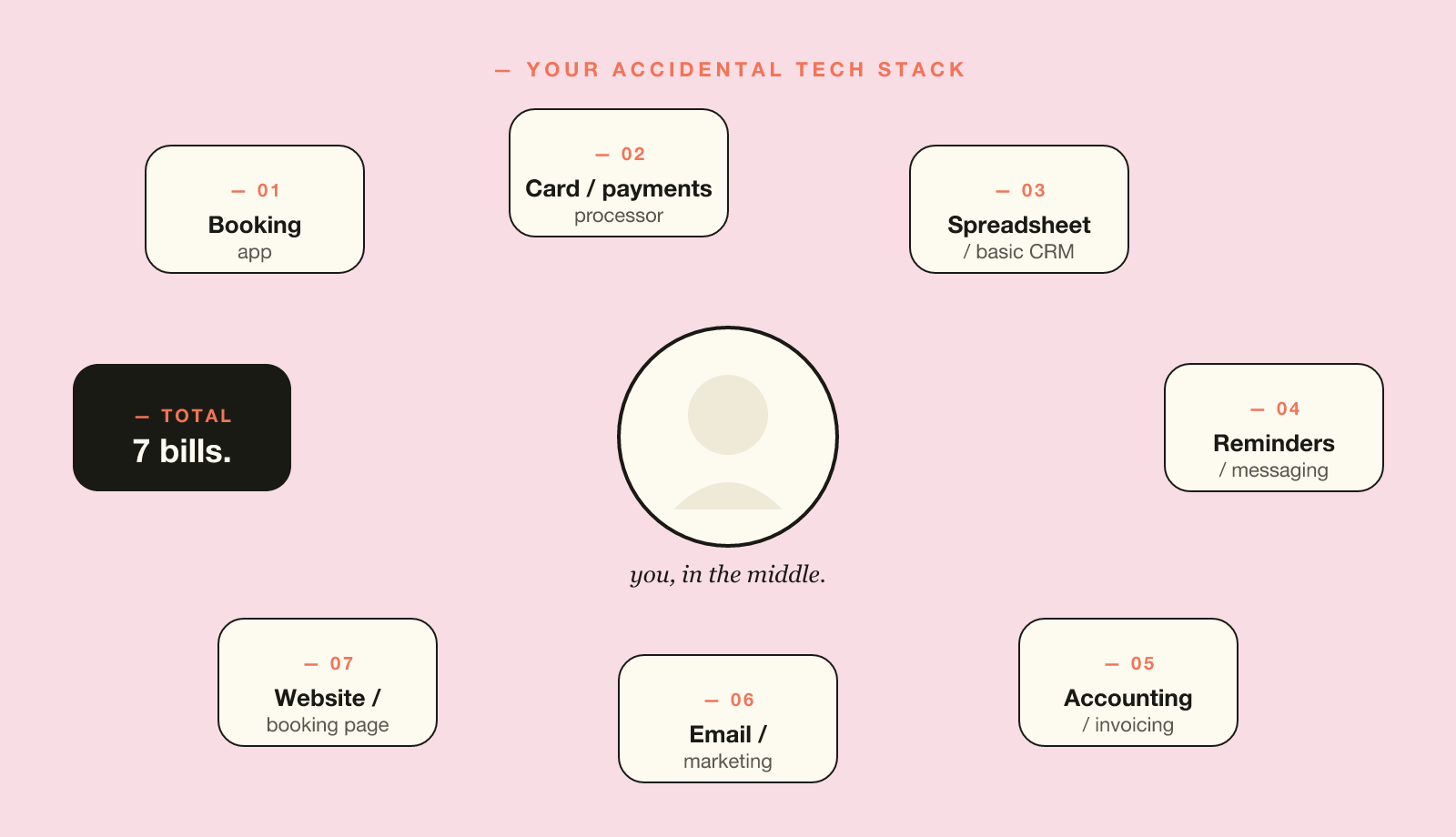
The 7 tools you're probably paying for
1. A booking tool
Whether it is a marketplace app or a simple calendar, you pay to let clients book. Many also charge commission on every booking, so the busier you get, the more they take.
2. A payment processor
Card machine, payment links or an online checkout. After all, something has to take the money. So it arrives with a monthly fee and transaction charges.
3. A spreadsheet or basic CRM
Somewhere to keep client details, treatment history and notes. For most owners, that means a spreadsheet. For most owners this is a spreadsheet held together by memory and good luck.
4. A reminder or messaging tool
To cut no-shows you send confirmations and reminders. Often through yet another paid app, or by hand on your phone.
5. An accounting or invoicing tool
For invoices, receipts and keeping HMRC happy. So that is another login and another subscription. That one is no longer optional either. Since 6 April 2026, Making Tax Digital applies to sole traders earning over £50,000, who must keep digital records. Cross the £90,000 VAT threshold and the paperwork grows again.
6. An email or marketing tool
For win-back messages, offers, and staying in touch with quiet clients. Powerful, but still one more bill.
7. A website or booking-page builder
Your online front door, where clients find you and then book. Useful — and, you guessed it, another monthly cost.
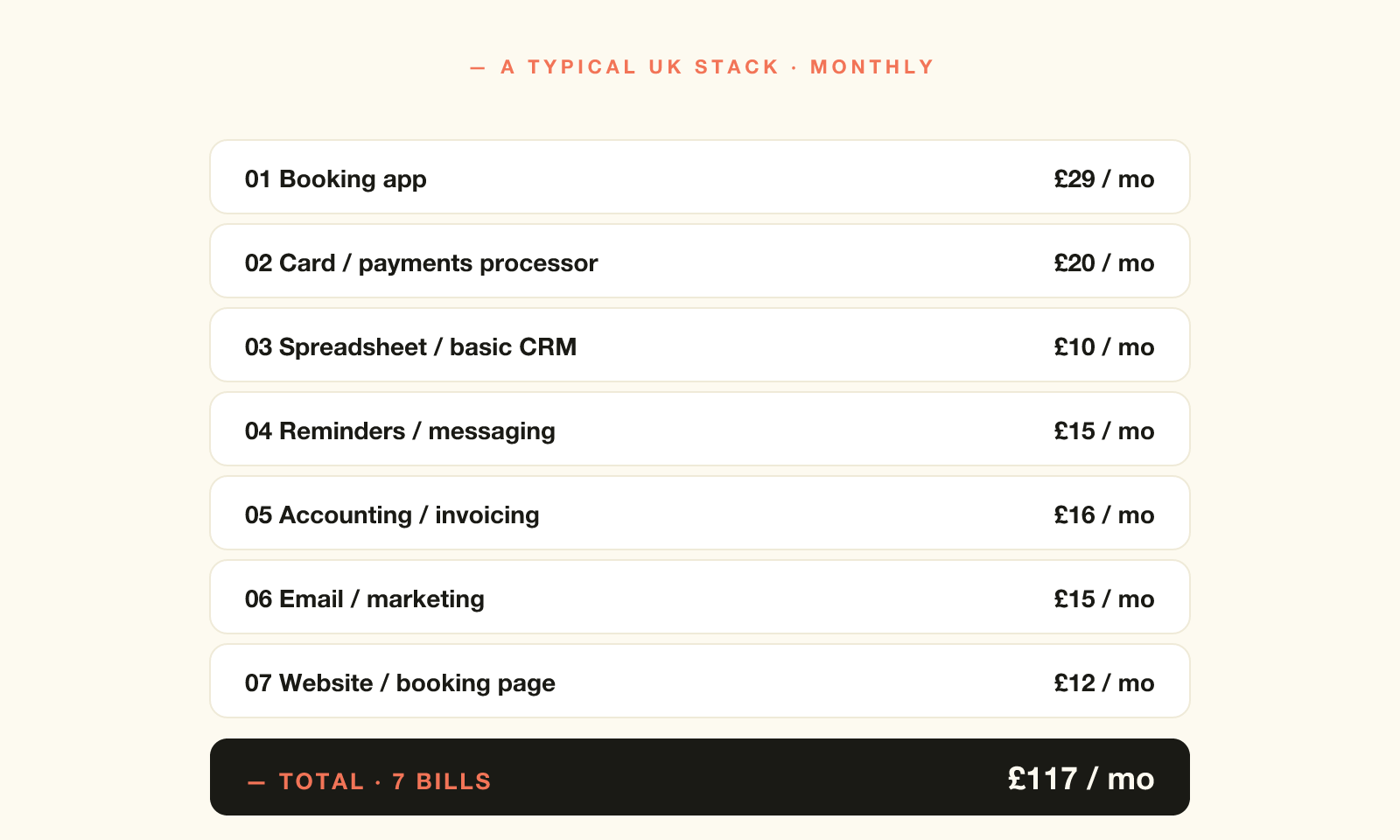
The hidden cost nobody adds up
Look at that list and the subscriptions add up fast. Often £75 to £150 a month, once you count them all. But the money is only half the story.
- Your time. Every tool that doesn't talk to the others means you re-type the same details over and over. A booking here, a client record there, an invoice somewhere else.
- The gaps. When information lives in seven places, things slip. A reminder doesn't go out. A client who hasn't been in for two months is never spotted. A payment is missed.
- The privacy headache. Each tool holds a piece of your clients' personal data. So you manage several privacy policies instead of one. Meanwhile the ICO expects you to account for each.
- The messy client experience. A confirmation from one app, an invoice from another, a reminder from a third. To your client, it feels disjointed.
None of this shows up on any pricing page. All of it shows up in your week. At least the subscriptions themselves are an allowable business expense, which softens the bill a little.
How salon management software replaces all seven
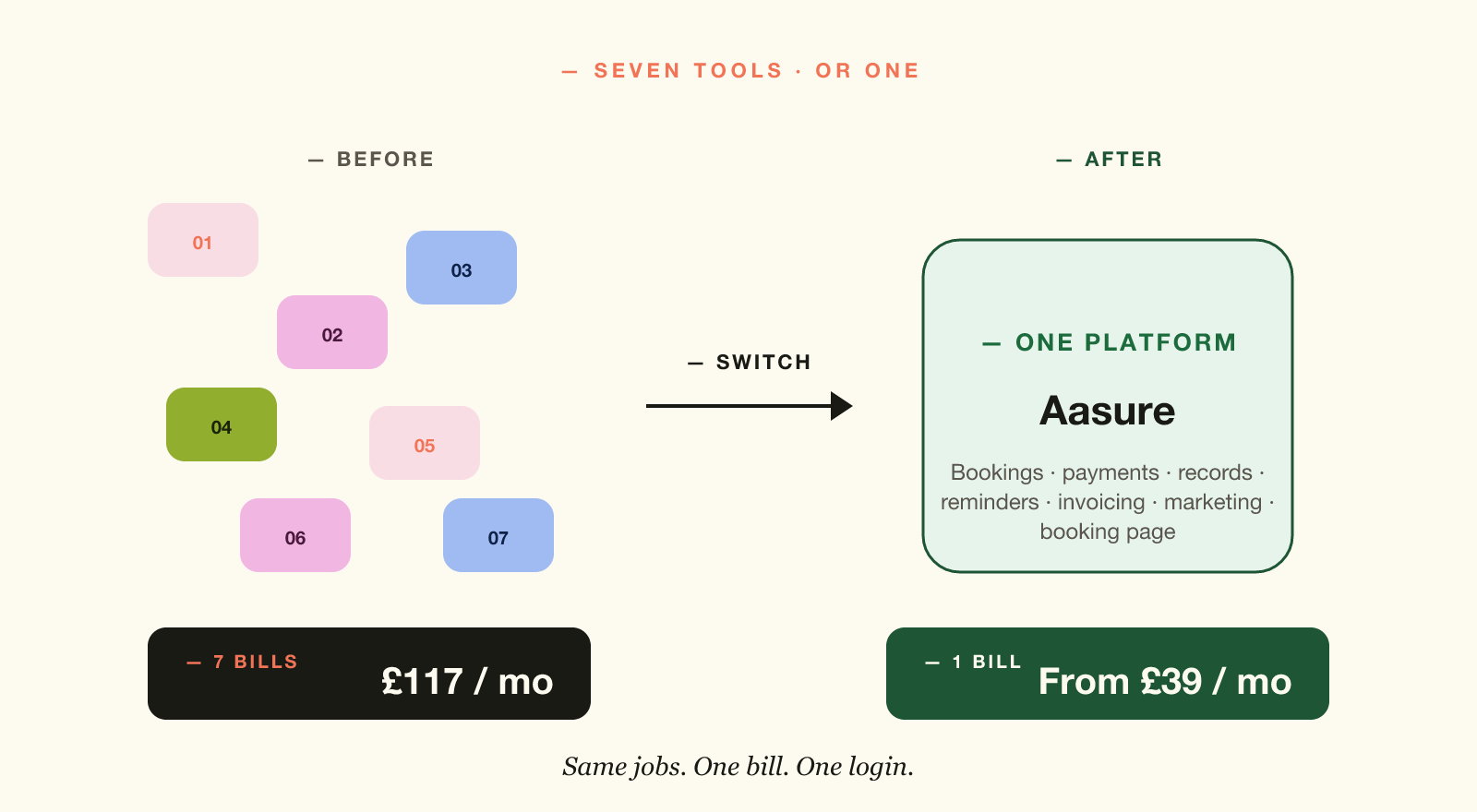
The fix is not a better booking app. Instead it is fewer apps. Specifically, one connected platform doing all seven jobs in the same place.
That is what all in one business management software means. Bookings, payments, client records, reminders, invoicing, marketing and your booking page all share the same information. So a client books, the record updates, the invoice raises itself and the reminder goes out. You never re-type a thing.
For most owners, switching to one tool means:
- One bill instead of seven, and usually far less than the stack it replaces.
- One login, rather than a juggling act.
- One privacy policy to keep on top of, instead of seven.
- One smooth experience for clients, from first booking to final invoice.
What to look for in salon management software
Not every platform sold as salon management software is built for a solo beauty business. So when you are choosing, check it has:
- A proper booking system for small businesses with your real availability and no commission per booking.
- Compliance you do not have to think about, including the skin-safety records HSE expects of salons.
- Built-in card payments, so invoicing happens automatically.
- Automatic reminders, and win-back messages when someone drifts.
- A single client record, so the full history sits in one place.
- Your own branded booking page, since a crowded marketplace buries you.
If you have weighed up the usual marketplace apps, consider a Fresha competitor built around one connected platform. A marketplace charges commission and keeps the client relationship at arm's length.
"But switching sounds like a hassle"
This is the worry that keeps owners stuck with seven tools. In reality the move is far smaller than the daily cost of staying put. Most platforms let you import your client list. Better still, you can switch between appointments rather than all at once.
So start by moving booking and reminders across, because those two save the most time. Then add payments and client records over a week or two. Finally, tell clients with a short, upbeat message:
I've moved to a new booking system to make things smoother for you — here's your new link!
Most will not notice the change behind the scenes. Instead they notice that booking with you got easier. A weekend of light setup then buys back hours every month.
The bottom line
You did not get into beauty to manage seven subscriptions. Every tool you add is one more login and one more bill. Worse, it is one more place for something to slip. So the calmest and cheapest setup is usually the simplest. That means a single platform doing the lot.
Add up what you pay across every tool this week. In practice that total is the push people need. The Federation of Small Businesses publishes wider running-cost research if you want the national picture. Meanwhile HMRC requires you to keep those records anyway, so tidy books are not optional.
Found this useful? The Hidden Cost of Marketplace Booking Apps goes deeper on commission. Meanwhile the Real Bill Calculator totals your stack against one platform in a minute.
One platform, not seven.
Aasure replaces the whole stack for solo beauty businesses. Branded booking with no commission, card payments, invoicing, reminders, client records and win-backs. One bill, one login, data held in the UK and EU.
Join the Waitlist →