
To become a self-employed hairdresser in the UK, first pick how you work. You can rent a chair, go mobile or work from home. Then check you are genuinely self-employed, because the label alone does not decide it. Next, register with HMRC and keep records. Finally, sort insurance and make sure your clients can follow you.
You are far from alone in this. In fact, 58% of people in hair and beauty are self-employed, according to NHBF's 2024 figures. So this guide covers each step in order, with the HMRC rules linked as you go.
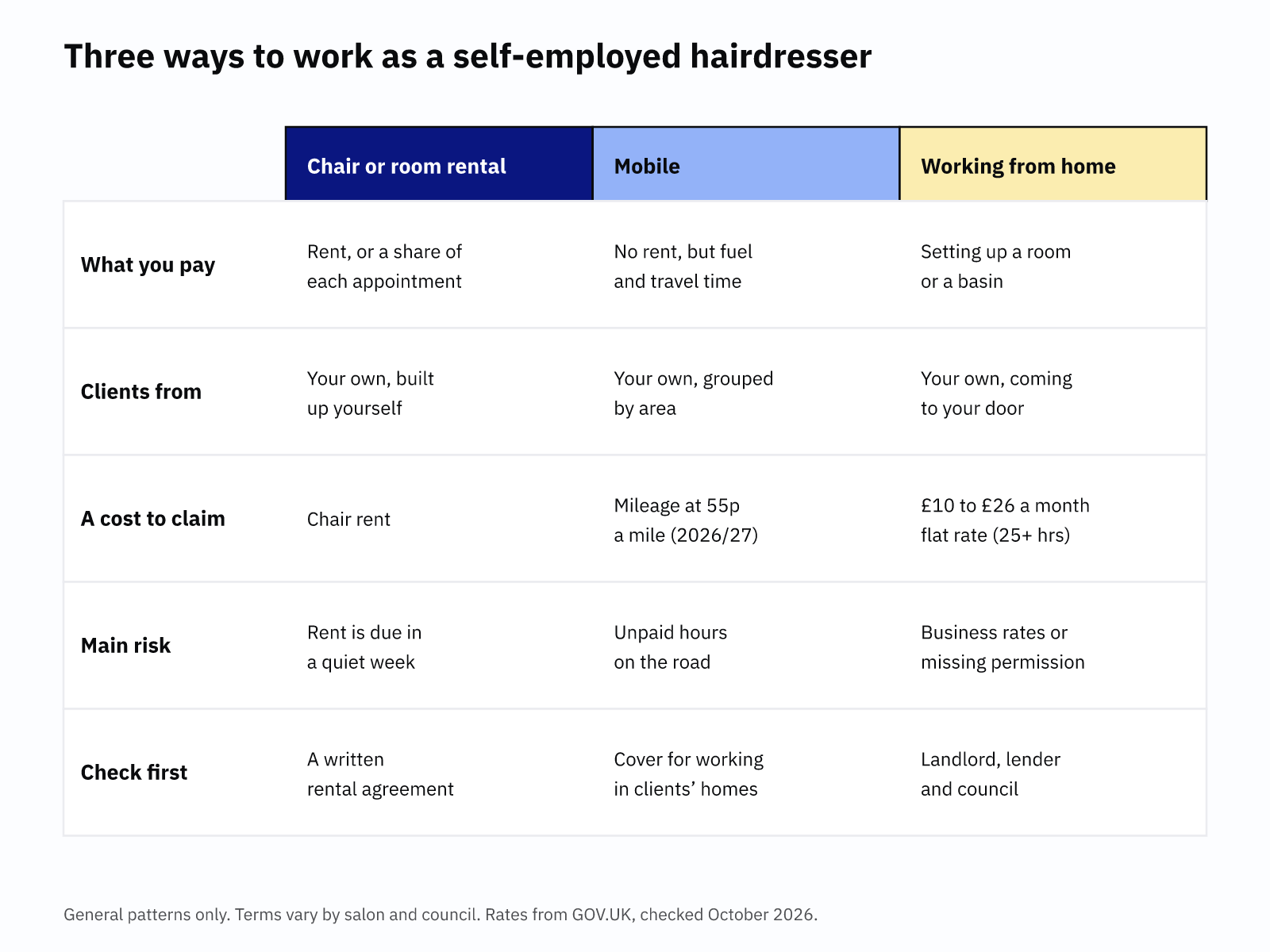
Three ways to work as a self-employed hairdresser
Most stylists start in one of three set-ups. Each one changes your costs, your risks and the tax claims you can make.
Chair or room rental. You pay a salon for a chair, then keep what your clients pay you. The rent may be a set fee or a share of each appointment. HMRC's own barbershop example describes a salon taking a commission per appointment as rent. In that case, a VAT-registered salon adds VAT to the rent. The upside is a ready-made salon. However, rent is still due in a quiet week.
Mobile. You visit clients at home, so there is no rent. Instead, travel time is unpaid, and fuel adds up. In 2026/27, you can claim 55p a mile for the first 10,000 business miles. That is a strong reason to group clients by area.
Working from home. Clients come to you, which saves rent and travel. That said, GOV.UK warns that you may need permission from your landlord or mortgage lender. You may also pay business rates on the room you use. So check all three before you fit a basin.
Check your status before you go self-employed
How the work happens decides whether you are a self-employed hairdresser, not the contract's title. HMRC looks at who sets your hours, your prices and your client list. Its hair and beauty guidance lists the signs on both sides.
For example, you are probably self-employed if you choose your days and set your own prices. Bringing your own clients points the same way. By contrast, a salon that sets your rota and pays a set rate is acting like an employer.
Using this list alone will not confirm your employment status.
So if the signs point both ways, use HMRC's free Check Employment Status for Tax tool. Also, read any rental agreement before you sign it. If a salon calls you self-employed but controls everything, you may really be a worker with rights. In that case, Acas offers free advice on 0300 123 1100.
Register with HMRC and set money aside for tax
Tax is simpler than it looks for a self-employed hairdresser. You register once, keep records all year, then file one return.
Register. You must send a tax return if you earned more than £1,000 from self-employment in a tax year. Then tell HMRC by 5 October after the tax year you started. After that, you file online and pay by 31 January.
Know the rates. In 2026/27, Income Tax is 20% on income from £12,571 to £50,270. On top of that, Class 4 National Insurance is 6% on profits from £12,570 to £50,270, then 2% above that. Scotland, however, sets its own Income Tax bands.
Plan for payments on account. Once your bill passes £1,000, HMRC asks for advance payments towards next year. As a result, your first January bill can be much bigger than you expect. So set money aside every month. For a basic-rate taxpayer, about a fifth of profit covers Income Tax and Class 4.
Also watch your takings. You must register for VAT once turnover passes £90,000 in 12 months.
Expenses a self-employed hairdresser can claim
Expenses lower your profit, which lowers your tax. HMRC lists the allowable expenses for self-employed people. For a self-employed hairdresser, they usually include:
- chair or room rent
- colour, products and stock you use on clients
- scissors, clippers, dryers and other kit
- insurance, bank charges and booking software
- training courses that refresh skills you already use
- business mileage
- a flat rate for working from home of £10 to £26 a month, at 25+ hours a month
Two traps catch stylists out. First, everyday clothing does not count, even black clothes you only wear at work. However, a uniform that is not everyday clothing does count. So does an apron or tunic you only use for work. Second, you cannot claim expenses if you use the £1,000 trading allowance instead. So pick whichever saves more.
Good self-employed hairdresser bookkeeping is mostly habit. Photograph every receipt, and log takings weekly. GOV.UK says to keep records for at least five years after the 31 January deadline.
Digital records are compulsory for more stylists each year, too. Making Tax Digital has applied since 6 April 2026 to sole traders with qualifying income over £50,000. From 6 April 2027, the line falls to £30,000. Our guide to Making Tax Digital for sole traders explains what changes.
Insurance and the other things you need
Most business insurance is optional for a sole trader, with one main exception. If you employ anyone, employers' liability insurance is compulsory, with a few exceptions, such as employing only family. You can be fined £2,500 for every day without it.
Public liability insurance is not a legal requirement, as one broker's guide confirms. Even so, a salon may ask chair renters to show it. It generally covers claims if you hurt a client or damage their property. By contrast, treatment liability covers claims about the service itself, such as a reaction to colour. Meanwhile, home insurance may not cover clients visiting your home, so check your policy.
Kit cover and income protection are further options. So compare what each policy excludes, not only the price.
Two smaller checks matter as well. First, the ICO says sole traders who use personal information may need to pay a data protection fee. Client phone numbers and colour notes count. Second, if you rent a chair, get the agreement in writing.
Keep your clients when you go self-employed
Your clients are the business, so plan how they will find you. Before you leave a salon job, read your contract for any clause that limits contacting clients. If one exists, take advice before you message anyone.
Also, do not copy the salon's client records on your way out. Instead, build your own list from day one. Then make your new booking link easy to find on social media and your Google profile.
Once clients arrive, keep them coming back. Rebook at the chair, before they leave. These rebooking scripts for hairdressers give you lines to copy. Our independent salon owner's guide covers pricing and no-shows next.
How much a self-employed hairdresser earns
We could not find an official figure for what self-employed hairdressers earn in the UK. The nearest is a salary figure. The National Careers Service gives an average hairdresser salary of £19,000 for a starter and £30,000 when experienced.
In practice, your income is your takings minus your costs. Chair rent, products, travel and insurance all come off first. That is why two stylists charging £60 a cut can earn very different amounts.
So work out your own figure, rather than trusting averages. Count your weekly takings, then subtract every cost. Then divide by all the hours you work, including admin. For booking, reminders and client records, see how Aasure works for salons and stylists. You can also compare the plans and prices. Note that Aasure does not file tax or replace accounting software.
This guide gives general information, not personal tax or legal advice. For a tricky case, check GOV.UK or ask an accountant.
Common questions
Are barbers self-employed?
Many are, but not automatically. HMRC's hair and beauty guidance covers barbers and stylists alike. It looks at who sets your hours, prices and clients. A barber who rents a chair and sets their own prices is probably self-employed. By contrast, a barber on a rota with a set wage is probably an employee.
What do I need to be a self-employed hairdresser?
You need an HMRC Self Assessment registration once you earn over £1,000 a year. You also need records of income and costs, and a place to work. Public liability insurance is not a legal requirement, but salons often ask for it. If you hire staff, employers' liability insurance is compulsory.
Does Making Tax Digital apply to self-employed hairdressers?
Yes, once your takings pass the threshold. Since 6 April 2026, it has covered sole traders with qualifying income over £50,000. From 6 April 2027, the line falls to £30,000, then to £20,000 from April 2028. HMRC counts takings before expenses. So check your own takings against HMRC's thresholds.
Find out what your chair really pays.
The free Real Pricing Calculator counts your rent, supplies, travel and unpaid hours. It shows your real hourly rate and what to charge per appointment.
Work out your rate