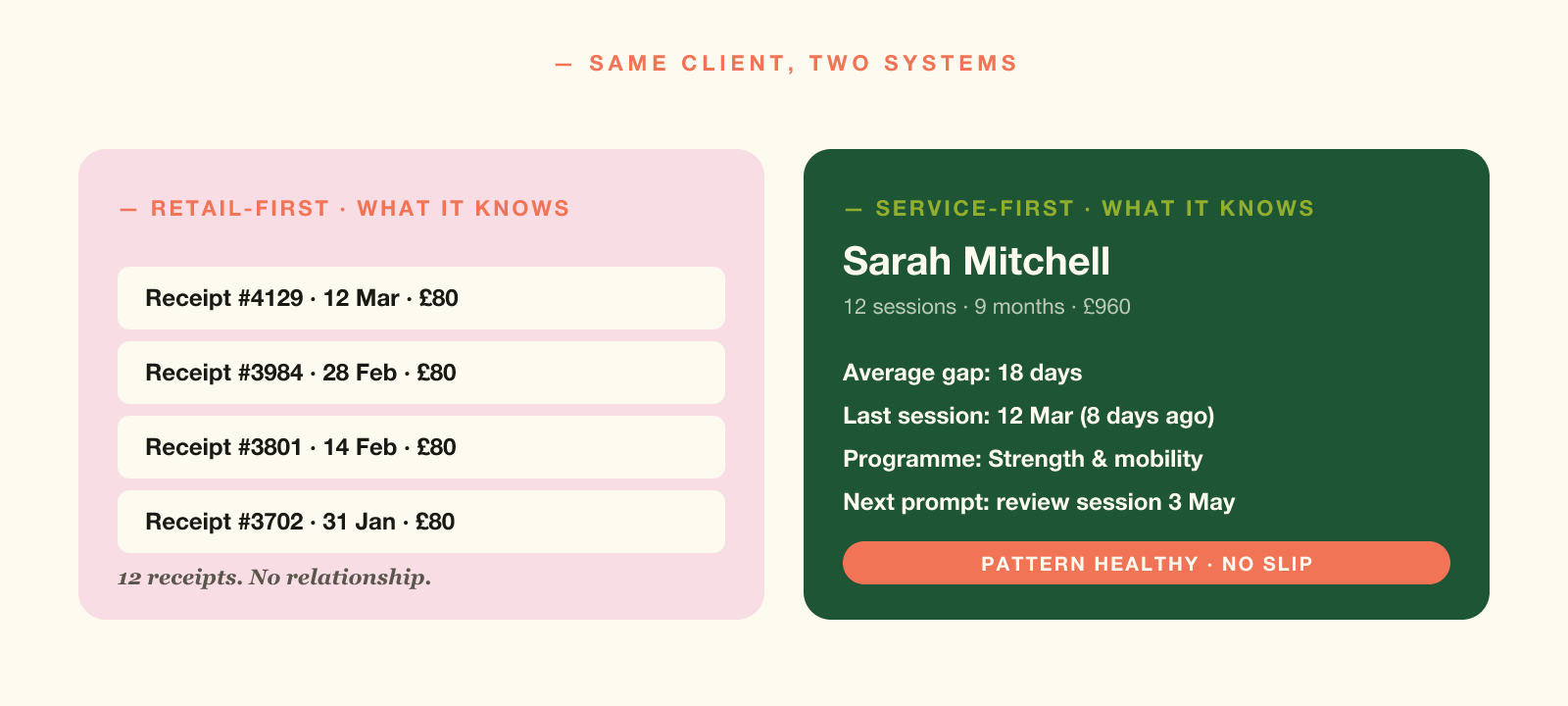
A POS system for salons is built to close a sale, not to remember a person. So when a personal trainer asked us about a client, the software struggled. "Sarah hasn't been in for two months. When was her last session? What did we work on? Has she paid for the ten-pack?"
The answer sat somewhere on screen. But finding it meant opening three tabs. Sales report, customer profile, then inventory of "items sold". So she found the receipts. She never found Sarah.
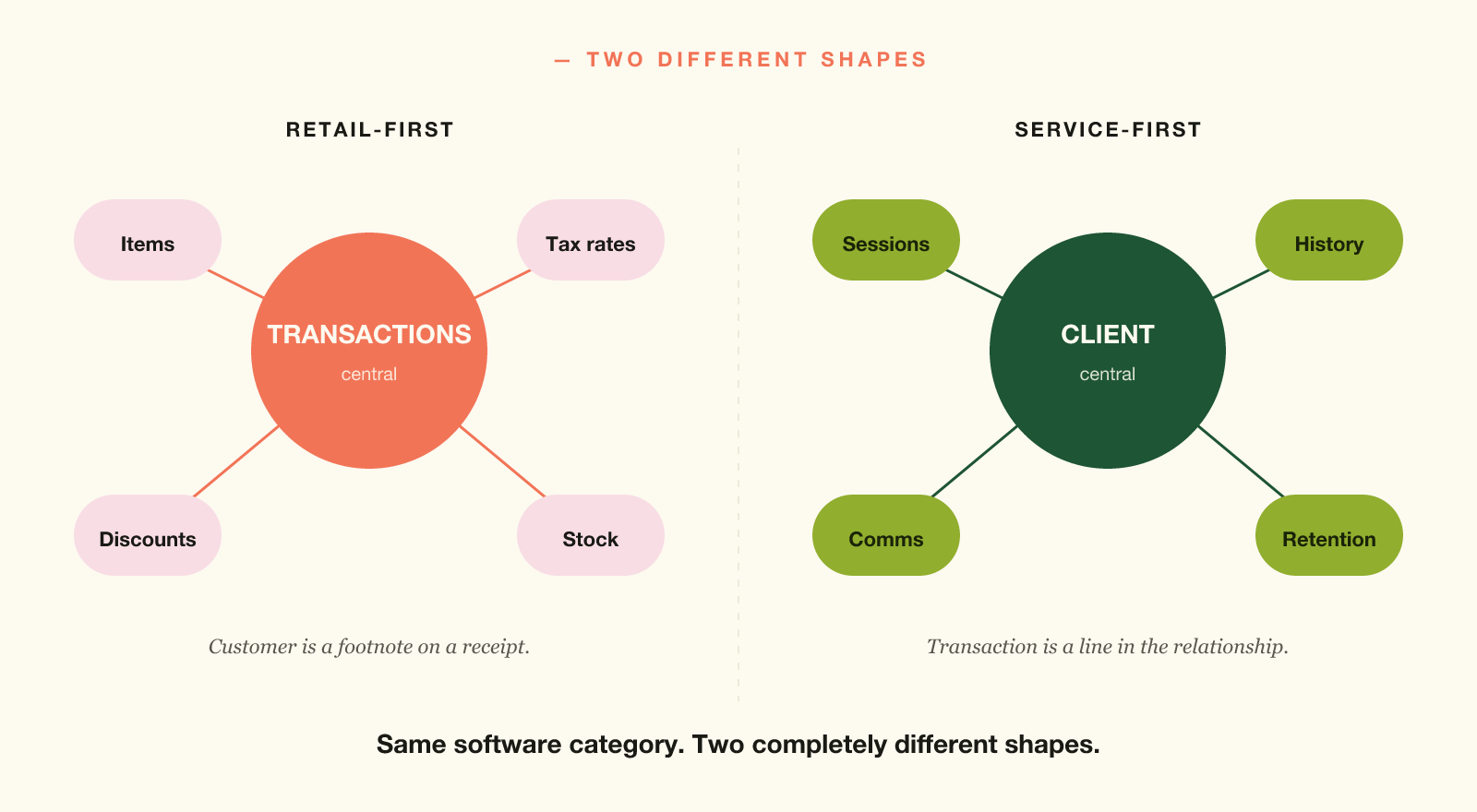
That is the gap. Retail-first software stores transactions, while service businesses run on relationships. One database structure cannot serve both. Worse, the mismatch grows as you do.
Retail-first tools centre on the till. Square, Shopify POS, Clover and SumUp all count what sold. They do not track who came in, or whether they return. For a coffee shop that is exactly right. But for a trainer, therapist or beauty pro it is the wrong shape. Square publishes its UK Appointments pricing if you want to compare.
A POS system for salons sells; it does not remember
Retail-first software follows a simple model. A customer walks in, picks an item, pays and leaves. So the software records the sale, takes the money and prints a receipt. That customer might return, or might not. The software does not care, because the transaction is its unit.
Service businesses do not work that way. The transaction is not the point. Instead the relationship is.
- You do not sell to a client once. Instead you build them up over months or years.
- Every session is connected to the one before and the one after.
- What you most want to know is not a transaction question. When did they last come in, and are they slipping?
- What grows the business happens between transactions. Winning back lapsed clients, deepening regulars, asking for referrals.
When the unit is the transaction, every relationship question turns hard. Not impossible, just hard. And whatever is hard gets skipped.
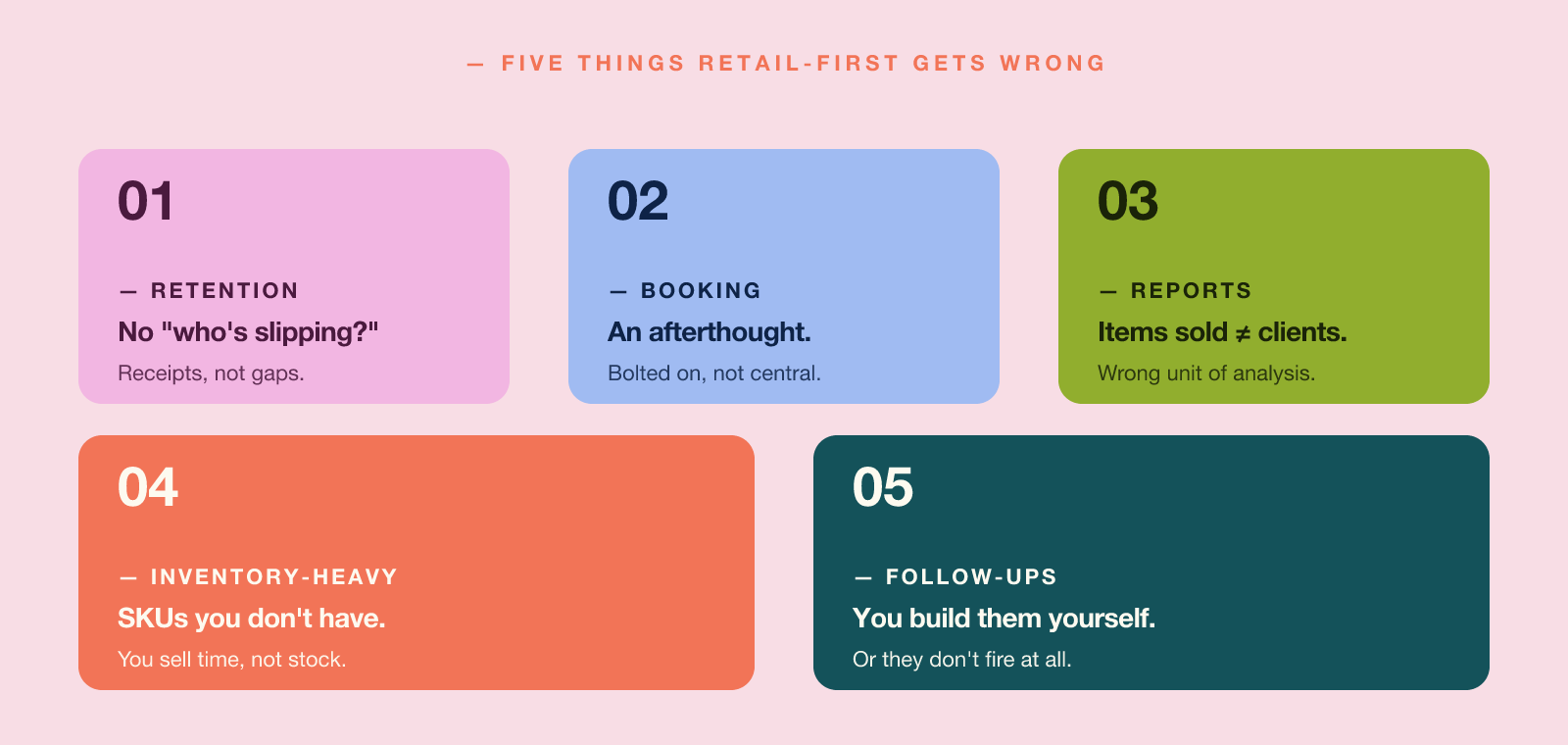
Five things a POS system for salons gets wrong
1. There's no retention reporting
The most valuable question is simple. Which of my clients are about to leave? Answering it needs a system watching gaps between visits. Retail-first software watches receipts instead. So it reports what sold last Tuesday, but never who has not booked in 60 days.
2. Booking is an afterthought
If the platform began as a payment processor, someone added the scheduler later. It works, yet it never became the centre of gravity. So reminders stay basic, cancellations feel awkward, and recurring slots take figuring out.
3. Reports show items sold, not clients seen
"This week you sold £2,400 in services." Useful enough. Now compare: "You saw 32 clients, 4 of them new, and 2 back after 90 days." Far more useful. But that second report does not exist here, because the data model never thinks in clients over time.
4. Inventory features dominate when you don't sell products
Half the menu covers stock levels, suppliers, SKUs and reorder points. Yet you sell time and hold no stock. The coffee-shop legacy shows everywhere. Salons do keep records, though: HSE expects skin-safety checks in hair and beauty work.
5. Follow-ups have to be built by you
None of the useful messages wire themselves to your schedule. Not the thank-you, the reminder, or the "haven't seen you in a while" nudge. So you build each workflow yourself, in a separate tool, then hope it fires.
Where it shows up in your business
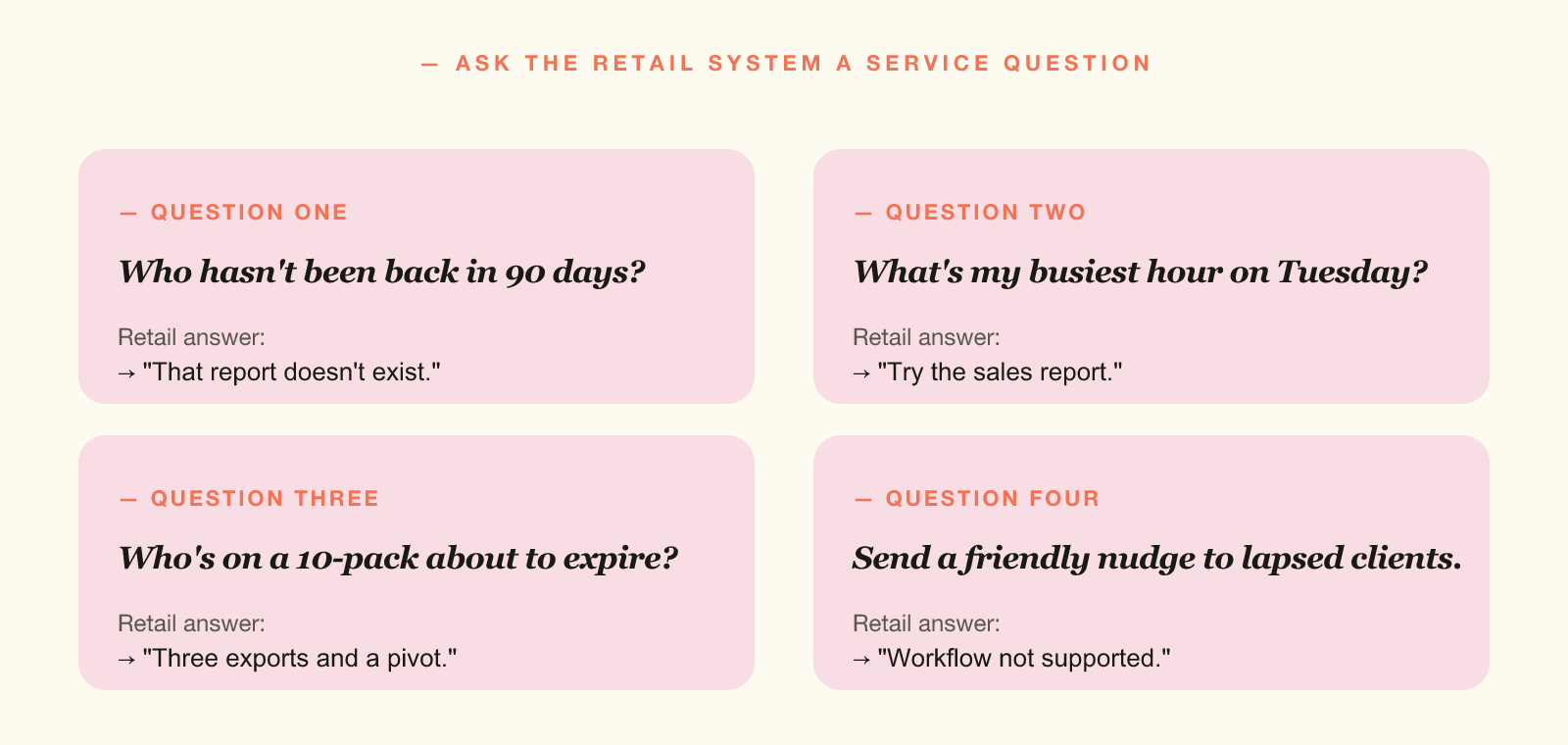
Usually you notice the mismatch only when you ask a relationship question.
- "Who hasn't been back in 90 days?" → reports menu doesn't have it.
- "What's my busiest hour on a Tuesday?" → not a sales-report question.
- "Which clients buy the multi-session pack?" → buried in three exports.
- "Send a friendly nudge to anyone whose 10-pack is about to expire." → not a workflow that exists.
So you stop asking. Instead you run on memory and a feel for who you have seen lately. That holds until you pass 30 or 40 active clients. Then a couple vanish unnoticed, and you are chasing ghosts.
"Retail-first software is excellent at answering 'what was sold yesterday.' Service businesses need software that's excellent at answering 'who's slipping this week.'"
What service-first software does differently
Same screens, different centre of gravity.
- The client record opens as the home page, rather than a sub-tab of the sales report.
- The morning brief shows who is slipping, rather than what you sold.
- Reminders run on the appointment calendar instead of the basket.
- Retention metrics come built in. Return rate, gap distribution and lapse alerts, all by default.
- Follow-ups, win-backs and thank-yous wire themselves to the booking flow, rather than waiting on you.
The change is not dramatic. Instead it is a thousand small defaults adding up to one feeling. This software thinks the way I think about my business.
How to know you've outgrown it
- You spent more than 30 minutes finding a client's history this month.
- You can't answer "who's slipping?" from inside your software.
- You've discovered a lapsed client too late more than once this year.
- Your "follow-up" workflow lives in WhatsApp and your head.
- Your reports show items sold, not relationships maintained.
- Half the menu items refer to inventory you don't have.
If three are true, the tool no longer fits. Fortunately, switching service software hurts far less than switching POS. Most of what you use lives in the client list, and that exports cleanly. Since UK GDPR gives you the right to your own data, an export is not a favour.
You built a service business because relationships are what you do best. So your software should agree. Worth noting too: software counts as an allowable expense. Meanwhile VAT registration starts at £90,000, and Making Tax Digital has applied since April 2026. The NHBF and the FSB both publish guidance for firms this size.
Common questions
Is Aasure an alternative to Square for service businesses?
For service businesses, yes. Card readers and retail-first tools were built around a transaction at a till. Aasure centres on the appointment and the relationship around it. Booking, history, follow-up and retention. Payments then sit inside that flow rather than at its centre.
Can I still take card payments through Aasure?
Yes. Aasure handles card payments beside the booking and client record. So one appointment ends with a full picture. Who came in, what they paid, and what comes next. You don't lose the till — you just stop running the business from it.
What's wrong with using a retail POS for a service business?
Nothing, until your business outgrows it. Retail systems index everything by transaction, which is right for a shop. Service businesses index by client — the same person, recurring, with history and a next appointment. Forcing a service practice into a retail database means the client view is always missing.
What's a client actually worth to you?
Use the free Client Lifetime Value Calculator to see long-term revenue per client. Then decide what retention is genuinely worth chasing.
Open the calculator → Or read: 5 Warning Signs a Client Is About to Cancel →